
Track where we have been!
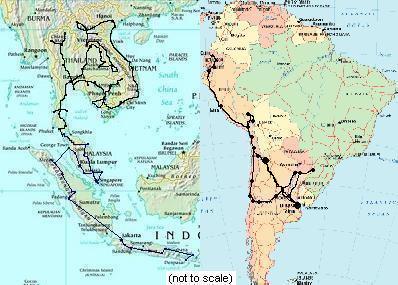
Monday, 29 December 2008
Christmas in Peru!

Thursday, 25 December 2008
Back in Peru, but seeing the sights this time
Entering Peru again we followed the same road south that we had travelled north on about a month earlier, but this time we stopped in more places. Our first real stop was Trujillo, about halfway to Lima, which is a nice city that has long since sprawled beyond the 16 or so blocks within the city walls remaining from when Francisco Pizarro founded the city ages ago. Some accommodations had closed for christmas so we got stuck paying a little more but having some luxuries like our own bathroom and cable TV for a change. Luckily exploring Trujillo doesn´t take very long so we were able to spend a day blobbing out watching movies.


Near Trujillo there are ruined cities of two civilisations, the Moche who lived in the first millenium AD and the Chimu who came after that (and who were taken over by the Incas around AD1500). We saw a Moche temple with partially unearthed murals carved on the inside, and the remains of a large palace complex built by the Chimu.
From Trujillo it was south again to Lima. We have found that getting around in Peru is easy if you want to go to Lima, or are in Lima going somewhere else. But if you´re already somewhere else, and want to go to another place that isn´t Lima, you are in for a bit of work walking around the different bus companies (often there isn´t a central bus station) trying to find a company that will stop to let you off in the town you want to go to, instead of driving straight through. The long distances don´t help, with most trips being 500-1000 km.
We´d already passed through Lima going north, and stayed in the trendy new part of town. This time we stayed in the older city centre, which was mad with the christmas rush. We stayed in a B&B kind of operation run by a local family, who had a christmas tree and decorations all set up. The old city was exactly what we expected with a collection of old churches, plazas and the large presidential palace. We didn´t have very good luck with the museums, as most of the ones we went to were closed, under renovation, or only running tours in spanish that day. But we did find our way almost by accident to an art gallery showing a collection of old italian art including lots of things by Salvador Dali and the famous The Thinker sculpture of the man with his head resting on his fist. We also stumbled upon a strange art exhibit that featured potatoes in every painting and scuplture, odd but fitting for a country with over 100 types of potatoes. Lima has an interesting monastery with old burial chambers containing the bones of about 25,000 people, which you can see on a tour.
South of Lima we found ourselves on a clear tourist trail taking in first the Ballestas Islands, near the town of Pisco, which are home to sea lions, pelicans, penguins and all sorts of other wildlife. Kind of a substitute for Ecuador´s Galapagos islands, for those on a budget. Also near Pisco is a giant image of a candleabra in a desert hill, for which no-one knows the origin. There are theories ranging from it being a Masonic symbol constructed by General San Martin at the time of the liberation of Peru, to it being the last remnant of an ancient culture.
More ancient symbols are to be found in the desert at Nasca, further south, where there are huge images and geometric shapes etched into the desert. The best (although most expensive) way to appreciate them is from the air, and the process of buying tickets is an adventure if you want to get the best deal. The formations at Nasca are surrounded by mystery with questions such as why would a culture make such big images that can only really be seen from above. Aliens, perhaps? Hmmm.
Throughout our time in Pisco and Nasca we kept running into the same people, who were obviously seeing the same sights in the same order. One American man was on our Islas Ballestas tour, our bus from Pisco to Nasca, and we also ran into him at the airport in Nasca. After we checked out of our hostel in Nasca we left our bags with the hostel people in a secure room, and when we came back to collect them we had no trouble - the lady said the room was already open with other tourists getting their stuff, because, as she said, everybody was on the same bus to Arequipa.
Links for the super keen:
Friday, 19 December 2008
Heading back south through Ecuador!
From Quito we headed to the small town of Riobamba, which has beautiful views of the towering Chimborazo Volcano from almost every point in town. We only spent a night in Riobamba, the main reason for coming was to take the famous devils nose train, which starts in Riobamba. It is one of the only passenger trains in operation in Ecuador and not maintained extremely well. The old train broke down a few months ago and now they have buses converted to operate on rails (which go faster). It was a fun train ride, the first time we have ridden on the roof of a train. On this particular train it is actually preferable to sit on the roof due to the view through the windows not being very good. The reason it is called the devils nose is because of the steep valley it descends, going both backwards and forwards over a series of switchbacks. The views from the train were great, especially travelling through the remote villages you do not get to appreciate on buses.
We got off the train in another small town called Alausi, which has no attractions and a suspicious bus timetable. We arrived thinking it would be easy to catch a bus to Cuenca, Ecuadors third largest city, but the only company in town told us that the bus had already left and there was not another one until tomorrow at 10am. Although back at the train station a group of tourists were waiting for the bus organised by some random guy and it turned out was with the same company.
Cuenca is quite a charming city and we spent three days exploring its sites. The highlight would have to be the thursday morning market. The local village women come to town laden with big carry baskets filled with fruits and vegetables and set themselves up along the streets. Cuencas other sights include its many churches and museums, as well as a museum of the famous Panama hats. Next to a picturesque river, the city is filled with lots of colonial archiquetecture and has the feeling of a much smaller Quito.
We left Cuenca a few days ago spending a night in sleepy Loja, further south, before changing to a bus to take us back into the north of Peru.
We got off the train in another small town called Alausi, which has no attractions and a suspicious bus timetable. We arrived thinking it would be easy to catch a bus to Cuenca, Ecuadors third largest city, but the only company in town told us that the bus had already left and there was not another one until tomorrow at 10am. Although back at the train station a group of tourists were waiting for the bus organised by some random guy and it turned out was with the same company.
Cuenca is quite a charming city and we spent three days exploring its sites. The highlight would have to be the thursday morning market. The local village women come to town laden with big carry baskets filled with fruits and vegetables and set themselves up along the streets. Cuencas other sights include its many churches and museums, as well as a museum of the famous Panama hats. Next to a picturesque river, the city is filled with lots of colonial archiquetecture and has the feeling of a much smaller Quito.
We left Cuenca a few days ago spending a night in sleepy Loja, further south, before changing to a bus to take us back into the north of Peru.
Tuesday, 9 December 2008
Exploring the Oriente & Quito!
From Baños we travelled through spectacular scenery. The road from Baños to Puyo (2 hours away) drops dramatically down to a jungle filled valley, with waterfalls shooting out of the cliffs. After Baños our destination was Tena (a further 3 hours from Puyo), and despite being the provincial capital of a very large province, the town was smaller than Baños. There isn´t much to do in Tena but our main reason for stopping was to check out possible jungle trips. It turns out the town doesn´t attract many tourists with the majority of the travel agencies listed in the lonely planet no longer existing. To do a bit more research on jungle trips we went 23km from Tena to an even smaller town, Misahualli, located on the fork of two rivers and backed by jungle. Misahualli is a very charming town and feels perfect for relaxing, with jungle edge roads to walk down and a beach by the river to watch the local troup of monkeys play. However, come night you realise that the perfecting resting location has only expensive food and the water in your hotel has stopped working. So we moved back to Tena the next day and booked ourselves onto a jungle trip for the following day.
On arriving back in Tena we found that there is one attraction in Tena (listed almost no where though), the Parque Amazonas - a small Island on the River that flows through the centre of Tena. It was actually a really interesting park with lots of animals found in the jungle, including a Tapir, Toucans, Mouse deer and monkeys. The park also has a couple of geese, which are not the friendliest, biting Kristal on the butt when her back was turned (maybe Kristal was a little close to their food or maybe Nic got his geese speak a tad wrong).
While on our jungle trip we stayed at Shangrila Lodge about 20km from Tena and the location was amazing, perched on top of a cliff giving sweeping views of the jungle and river below and the hills and volcanoes on the horizon. Absolutely beautiful. Our three days in the jungle were packed with trekking through virgin rainforest and climbing through canyons on the first day, visiting a nearby local Quichua village and tubing downriver on the second day and on the third trekking through primary rainforest, climbing waterfalls and tubing once again. We didn´t see a lot of animals on our treks but the Taratulas we stumbled upon whilst admiring a flying beetle was scary enough. Our three days were really enjoyable and well worth it.

[Our guide, Darwin, with the Taratula]
From Shangrila we heading north to Quito, Ecuadors capital city. Quito is a very long city about 60km long and 13km wide, the reason being it is located in the many valleys in the highlands with big volcanoes on the sides. We arrived in Quito for the last few days of the annual Quito festival, which actually goes for two weeks. It celebrates the founding of the city and there is music and people everywhere. We saw numerous marching bands and party buses. It made for a very hectic feeling welcome to the city.
The weather in Quito is very unpredictable, being in the highlands its common to have sunshine and hail storms within a few hours of each other, as we discovered. The city has a lot of old colonial buildings, narrow streets and gorgeous churches including the Basilica del Voto Nacional, which we climbed up the top of the steeple for awesome views.
Whilst in Quito we went on a day trip to a small town 2 hours north called Otavalo. It is famous for its Saturday Market, which takes up the main plaza and several blocks. It was very big and it is meant to be the biggest hand crafts market in South America. We spent a bit of money on souvenirs, finding it easier to bargain later in the afternoon when people are about to head home.
We leave Quito tomorrow, glad to be moving out of the bustle. We are heading South again, making our way to Riobamba a small town that is the start of an excellent train ride.
Subscribe to:
Posts (Atom)