We entered Peru via colectivo or shared taxi, arriving in Tacna on the Peruvian side of the border. Border towns are usually a little dodgy so we headed straight through and onto a bus to the bigger city of Arequipa, on the way noticing the large Peruvian military presence near the border and the huge murals on the side of the desert sand dunes. Many of the murals were probably made by the army because they had military and nationalistic themes.
Arequipa is a nice town, at least in the centre where we stayed, with cobblestone streets and colonial buildings surrounding the central plaza. The city has a collection of old churches and an interesting old convent that is a kind of city within a city, with its own community and streets within a walled area. On our arrival we immediately started to ignore the advice of the owner of our last guesthouse in Chile, and look for the places where the locals eat. We weren´t disappointed - there are many local eateries in town selling a set menu for lunch and dinner for around US$1. You get a huge amount of (presumably) traditional Peruvian food, with a soup for the first course followed by a second course with meat, veges and many types of potatoes. The locals were welcoming as we found ourselves waiting with the others at midday for the popular place on our street to open, and an old lady who was also waiting ushered us in when it did.
After a few days in Arequipa to figure out how things work in Peru, we began our big push 2500km north to Ecuador, stopping only for a day in Lima at the halfway point. The APEC meeting was just about to start when we were there, with streets blocked off and police officers all around. We didn´t manage to get the photo of John Key sightseeing on the taxpayer dollar.
Around 20 hours further north and after a change from our first class Peruvian bus to a somewhat less comfortable Ecuadorian one, we crossed into Ecuador. It was here that the coastal desert we´d followed since around Santiago finally ended and we began passing endless banana plantations instead. Occasional small towns were filled with fruit venders, and we bought four mangoes for $1 from one of the many salesmen who jump on the buses whenever they stop for a few minutes. In terms of atmosphere it was like stepping back to Indonesia.
After this introduction we were quite surprised when we arrived in Guayaquil, Ecuador´s largest city, to pull up at a huge modern multi-storey bus station that looked more like an airport. The city itself is quite clean and modern and not at all like the rural areas we´d passed through. There has been some imaginative civic development with the waterfront area, which apparently used to be crime-ridden and a very dangerous place, being transformed into a 3km long promenade with parks, restaurants and food venders, and usually filled with people. Also, someone had the idea to fill the downtown Parque Bolivar with Iguanas that roam around being fed by visitors. You´ll have to see our pictures to believe it (click the link on the blog page).
Being a relatively small country (about the size of NZ, but with 3 times the populaton) getting around is quite easy. Going back to the airport/bus station, we bought a ticket from one of the 100 ticket booths for one of the numerous departures going northeast into the highlands. As we got further away from the coast the scenery became more and more spectacular with hills and volcanoes separated by deep valleys. Late in the day we arrived in Banos, literally ¨bathing place¨or similar, although that´s also what they call the toilets in South America. This small town is all about the hot springs from the volcano that it sits under. Even the church is dedicated to the town´s patron saint ¨The virgin of the holy water¨and is filled with paintings of people being saved from disaster by the saint. The springs make the town a real tourist destination for Ecuadorians and virtually every building in the centre is tourism oriented. Midweek and in the off season, we found the place nice and relatively quiet. The setting, in a valley surrounded by hills and with the volcano somewhere in the clouds, make for a relaxing few days.
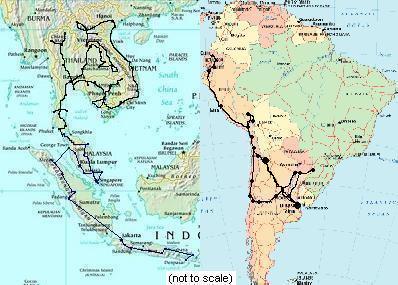
Track where we have been!
Thursday, 27 November 2008

Thursday, 13 November 2008
Heading north through Chile

Tuesday, 4 November 2008
3 weeks in Argentina!
We left Buenos Aires heading north, towards the waterfalls at Iguazu. Our first stop was the city of Rosario, about 4 hours away. Rosario is a pretty city, with the spring blossoms all out and the outside of our hostel was covered with colourful flowers. Rosario was a nice town colder than we expected but then so is everywhere. It was once Argentina´s second largest city but you wouldn´t really guess - it has more of the feel of Palmerston North like a laid back provincial town. There is a definite sense of pride in Rosario, which is seen by the massive monument to the national flag which was created in Rosario. It was in Rosario that we found the country has ¨cheap wine syndrome¨ - which isn´t to say that the wine is bad (it´s not) but rather that in a cafe any two given drinks cost about the same as a bottle of the house red. So....... lets just say parking yourself down at a cafe isn´t a bad way to spend your afternoon if you´ve already finished your sightseeing.
Next we travelled to San Ignacio - a very small town where nothing opens until well after siesta. San Ignacio is home to the ruins of a Jesuit mission, which attract quite a few tour buses. In Argentina´s early colonial history the Jesuits were active in this part of the country and set up a number of self-sufficient communities. They converted the local indigenous people to catholicism and organised them to support themselves through agriculture. The Jesuit priests were the heads of these communal societies, some of which were quite large, and helped improve living conditions by introducing european agricultural technology. The success of their order began to grate on those in charge of the country at the time and they were eventually ordered to leave, after which the communities they had founded gradually disappeared. The ruins at San Ignacio were once home to around 5,000 to 10,000 people over a 100 year period.
After San Ignacio it was onto the very touristy town of of Puerto Iguazu about 20kms from the Iguazu National Park, home to the Iguazu Waterfalls. It is located at the top of Argentina and the park shares borders with Brazil and Paraguay. The town itself has nothing of value to see and feels like a tourist factory. However, the waterfalls are absolutely breathtaking, the sound and the force of the water crashing over the numerous cliff faces is amazing. We spent a couple of days visiting the national park firstly to see the waterfalls and then to walk through the jungle where we got to see lots of animals.
From Puerto Iguazu we travelled back south to Resistencia (yes we know we have travelled a long way and not written a blog and this isn´t the last place we have visited). Resistencia is a small city which still has unpaved dirt streets and horse & carts trotting around laden with vegetables. It´s a town where you are basically forced to live like an Argentinan, when the only sandwich spread for sale at the biggest supermarket is Dulce de Leche (a traditional Argentine caramel spread), everything closes for siesta and the restuarants don´t open until after 8pm for dinner. So we´ve bought our own supply of Dulce de Leche, napped through siesta and eaten out after 8.30pm (which is actually still early the place was starting to get crowded at 10pm when we left). Resistencia doesn´t see a lot of tourists so when we visited the information centre and the local scuplture museum we got special attention. The city´s main tourist attraction is the hundreds of sculptures dotted around the centre, which are added to every two years in a massive sculpture festival. One notable sculpture is the memorial of Fernando, a local stray dog who became a local character and was befriended by a bank manager, sharing breakfast with him in his office. The dog lived in the central park and was so loved by the people that when he died there was a public funeral in his honour.
Next on our journey back south was Cordoba in the centre of Argentina. Cordoba has an interesting mix of architecture, with the central square surrounded by a combination of civic buildings, old Jesuit constructions, and churches. Throughout the rest of the town´s centre it´s not uncommon to find old colonial structures next to modern apartment blocks, or historic churches, while the leafy pedestrian shopping streets run through it all. From Cordoba we visited the nearby town of Alta Gracia, home to an old Jesuit Estancia, as well as Che Guevara´s childhood home. It was interesting to see the models of the tools the Jesuits used, and the large dam they had constructed on the river next to their main buildings.
After Cordoba we headed to Mendoza in the heart of Argentina´s wine country and backing onto the Andes mountain range. Mendoza is a quite compact city, which is actually surrounded by desert. Although the city is as green and leafy as any city we´ve seen in Argentina thanks to the intricate network of irrigation channels. This irrigation spreads out into the surrounding Mendoza area and is partly why the area produces the majority of Argentina´s wine. The other reason is the semi-arid conditions that make for very predictable weather patterns and perfect wine producing conditions. To make sure we weren´t missing out on investigating the intricate irrigation systems we had to go visit a few wineries and try some of this excellent wine.
Mendoza was our last stop in Argentina for the time being. A couple of days ago we took the spectacular 6 hour bus trip across the Andes to Santiago, the capital of Chile. Much of the snow in the Andes has already melted but it was a unique trip climbing up to around 4000m above sea level, going through the border crossing formalities at the top surrounded by snowy peaks, then taking the windy road back down through vineyards on the Chilean side.
Next we travelled to San Ignacio - a very small town where nothing opens until well after siesta. San Ignacio is home to the ruins of a Jesuit mission, which attract quite a few tour buses. In Argentina´s early colonial history the Jesuits were active in this part of the country and set up a number of self-sufficient communities. They converted the local indigenous people to catholicism and organised them to support themselves through agriculture. The Jesuit priests were the heads of these communal societies, some of which were quite large, and helped improve living conditions by introducing european agricultural technology. The success of their order began to grate on those in charge of the country at the time and they were eventually ordered to leave, after which the communities they had founded gradually disappeared. The ruins at San Ignacio were once home to around 5,000 to 10,000 people over a 100 year period.
After San Ignacio it was onto the very touristy town of of Puerto Iguazu about 20kms from the Iguazu National Park, home to the Iguazu Waterfalls. It is located at the top of Argentina and the park shares borders with Brazil and Paraguay. The town itself has nothing of value to see and feels like a tourist factory. However, the waterfalls are absolutely breathtaking, the sound and the force of the water crashing over the numerous cliff faces is amazing. We spent a couple of days visiting the national park firstly to see the waterfalls and then to walk through the jungle where we got to see lots of animals.
From Puerto Iguazu we travelled back south to Resistencia (yes we know we have travelled a long way and not written a blog and this isn´t the last place we have visited). Resistencia is a small city which still has unpaved dirt streets and horse & carts trotting around laden with vegetables. It´s a town where you are basically forced to live like an Argentinan, when the only sandwich spread for sale at the biggest supermarket is Dulce de Leche (a traditional Argentine caramel spread), everything closes for siesta and the restuarants don´t open until after 8pm for dinner. So we´ve bought our own supply of Dulce de Leche, napped through siesta and eaten out after 8.30pm (which is actually still early the place was starting to get crowded at 10pm when we left). Resistencia doesn´t see a lot of tourists so when we visited the information centre and the local scuplture museum we got special attention. The city´s main tourist attraction is the hundreds of sculptures dotted around the centre, which are added to every two years in a massive sculpture festival. One notable sculpture is the memorial of Fernando, a local stray dog who became a local character and was befriended by a bank manager, sharing breakfast with him in his office. The dog lived in the central park and was so loved by the people that when he died there was a public funeral in his honour.
Next on our journey back south was Cordoba in the centre of Argentina. Cordoba has an interesting mix of architecture, with the central square surrounded by a combination of civic buildings, old Jesuit constructions, and churches. Throughout the rest of the town´s centre it´s not uncommon to find old colonial structures next to modern apartment blocks, or historic churches, while the leafy pedestrian shopping streets run through it all. From Cordoba we visited the nearby town of Alta Gracia, home to an old Jesuit Estancia, as well as Che Guevara´s childhood home. It was interesting to see the models of the tools the Jesuits used, and the large dam they had constructed on the river next to their main buildings.
After Cordoba we headed to Mendoza in the heart of Argentina´s wine country and backing onto the Andes mountain range. Mendoza is a quite compact city, which is actually surrounded by desert. Although the city is as green and leafy as any city we´ve seen in Argentina thanks to the intricate network of irrigation channels. This irrigation spreads out into the surrounding Mendoza area and is partly why the area produces the majority of Argentina´s wine. The other reason is the semi-arid conditions that make for very predictable weather patterns and perfect wine producing conditions. To make sure we weren´t missing out on investigating the intricate irrigation systems we had to go visit a few wineries and try some of this excellent wine.
Mendoza was our last stop in Argentina for the time being. A couple of days ago we took the spectacular 6 hour bus trip across the Andes to Santiago, the capital of Chile. Much of the snow in the Andes has already melted but it was a unique trip climbing up to around 4000m above sea level, going through the border crossing formalities at the top surrounded by snowy peaks, then taking the windy road back down through vineyards on the Chilean side.
Subscribe to:
Posts (Atom)