We began our journey to the northeast of Cambodia with a bus trip to Kratie, about 6 hours north of Phnom Penh. Kratie is a small town, with cows that roam the streets and baby goats that jump around the fences. It's good to be in a small Cambodian town and soak up the atmosphere in the market and around, although there isn't much else to do. The only real "sight" to see is the endangered Irrawaddy dolphins that live in the Mekong river near Kampi, 15km from Kratie town. The road to Kampi is interesting as you pass by stilt houses, locals building boats, haystacks on stilts, and cows eating from the haystacks. On the Mekong itself it was very peaceful to be paddled through the mangrove forests in a small boat while the dolphins played nearby.
From Kratie we continued north to Ban Lung, a place that claims to be a provincial capital. Ban Lung feels like it's in the middle of nowhere, 600km from the main east-west road that connects Cambodia to Thailand and Vietnam, and 4 hours by bumpy dirt road east of the road to Laos. With the dusty dirt roads that run through the town "centre", it wasn't quite the tropical paradise that Kristal imagined spending her birthday at. But the serene setting of the nearby Yeak Leom crater lake and nearby waterfalls made up for this. We also had a nice place to stay in a guesthouse by a small lake just out of town, that used to be the governor's residence (the house, not the lake).
The isolated location backfired on us when it came time to leave - we had been planning to fly to Siem Reap in the west of Cambodia but there were no flights at all. As one of the staff at our guesthouse said, "the airport is mud". He was right. The runway is basically an area of dirt that locals use as a shortcut for their motorbikes. No doubt the windsock stops them getting lost. So, we ended up going to Siem Reap by bus over a two-day 18 hour journey. With our luck, after three days of sunshine the brief thunderstorm two hours before we left turned the roads to sludge which didn't help with the trip. Nevertheless this part of Cambodia was very interesting to see, an area where there aren't that many tourists and you can see the local life up close, and where the kids haven't yet been taught to ask you for money.
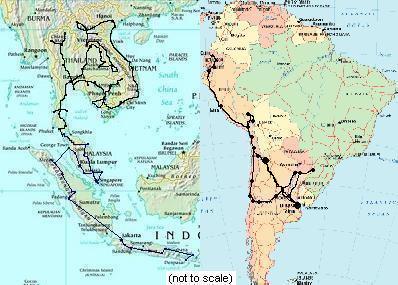
Track where we have been!
Sunday, 31 August 2008

Saturday, 23 August 2008
A drowned rat, a decapitated pigs head - Phnom Penh & South Cambodia
We arrived in Phnom Penh at night to torrential rain and flooded streets - you would think 'not a good start' but driving around in flood streets can be quite exciting. The following day we got to see what Phnom Penh really looked like - including the muddy residue all over the road from the flooding and the poor little rat that didn't quite make it.
Phnom Penh is quite a nice city and feels a lot like Thailand. We spent our time exploring the sights including the royal palace and its Silver Pagoda, so named for its impressive silver floor tiles, which were unfortunately mostly covered by carpet. The city has lots of wide open streets with greenery planted around and french style buildings. It seems like every government building looks like a temple. Development is booming with lots of new buildings being constructed. The markets around the city are quite good - we've stocked up on lots of cheap clothing and shoes - due to the western garment factories being on the outskirts of the city.
One of the highlights (?) was visiting the Chueng Ek killing fields and the Toul Sleng Prison where they kept people before sending them off to be brutally killed under the Khmer Rouge regime of Pol Pot. It was estimated that around 2 million people were killed by the Khmer Rouge. At the killing fields you can see the sights of the excavated mass graves, clothing and bones of nearly 8000 victims. The prison has been maintained and is virtually the same as when it was abandoned by the Khmer Rouge. See our photos.
From Phnom Penh we headed south to the beach side town of Sihanoukville where we spent a few days lying around on the beach. It's a small town although Kampot where we went next was smaller. It was good to see local life outside of the big city. We finished a loop of these places by coming back to Phnom Penh and have bus tickets booked to head up to the northeast of the country tomorrow.
Check our photos for the picture of the decapitated pigs head.
Phnom Penh is quite a nice city and feels a lot like Thailand. We spent our time exploring the sights including the royal palace and its Silver Pagoda, so named for its impressive silver floor tiles, which were unfortunately mostly covered by carpet. The city has lots of wide open streets with greenery planted around and french style buildings. It seems like every government building looks like a temple. Development is booming with lots of new buildings being constructed. The markets around the city are quite good - we've stocked up on lots of cheap clothing and shoes - due to the western garment factories being on the outskirts of the city.
One of the highlights (?) was visiting the Chueng Ek killing fields and the Toul Sleng Prison where they kept people before sending them off to be brutally killed under the Khmer Rouge regime of Pol Pot. It was estimated that around 2 million people were killed by the Khmer Rouge. At the killing fields you can see the sights of the excavated mass graves, clothing and bones of nearly 8000 victims. The prison has been maintained and is virtually the same as when it was abandoned by the Khmer Rouge. See our photos.
From Phnom Penh we headed south to the beach side town of Sihanoukville where we spent a few days lying around on the beach. It's a small town although Kampot where we went next was smaller. It was good to see local life outside of the big city. We finished a loop of these places by coming back to Phnom Penh and have bus tickets booked to head up to the northeast of the country tomorrow.
Check our photos for the picture of the decapitated pigs head.
Monday, 18 August 2008
South Vietnam
Moving on south through Vietnam we visited Hoi An, an old trading port city that fell on tough times when most shipping traffic shifted to Hue to the north. The town has a lot of cultural heritage and tourism has filled the economic gap, with literally hundreds of small tailors, clothing and souvenir shops all popping up selling the same thing. It's a strange mix with these shops dotted between old temples, chinese clan houses, and an ornate japanese-designed bridge. You can't walk 10m down the street without someone trying to sell you something, and frustratingly despite there being so many vendors if you ask any of them for a price they act as if you haven't talked to anyone else in the city and quote you something outrageous. Nevertheless Hoi An was a good place to have a suit made and has its own unique types of delicious food. Near Hoi An we visted the ancient My Son temple complex, built from 500-1,000AD by the Cham people who used to live in the area. Most of the temples were destroyed during the war by US bombers when the Viet Cong used the complex as a base.
A trip south by night bus led us to the beach town of Nha Trang, a popular holiday spot among Vietnamese. We learnt here the difficulties of looking for a hotel room when your bus arrives at 6am. Most places were full because people hadn't checked out yet, and interestingly we were quoted different room rates when we asked at one hotel at different times. (This sort of thing is typical of travel in Vietnam. We met one couple who went to the travel agent to pay for their bus ticket and the staff had to go and check what price they had been quoted.) We spent a day exploring the local Cham temples and a fishing village where the locals live under the local bridge, before settling down on the beach for a few days. Once you rent your deckchair for the day the beach is an easy place to be with hawkers walking past selling food, drink and books. After a little bit of this you find out its better to stay in the deckchairs with the security guard where the hawkers aren't allowed to bother you, but hang around just outside the area.
One thing that we've noticed throughout southeast asia but stands out in Nha Trang is the concept of "Happy Hour". At bars happy hour often runs all afternoon. Many have happy hour starting at 9am. In Laos we saw one sign saying "Now every hour is happy". On the beach in Nha Trang there was a lady selling fruit who walked around all day shouting "Pineapple Mango Banana! HAPPY HOUR!". We asked her what time happy hour was but she didn't seem to understand.
Another night bus trip led us to Saigon, formally known since the war as Ho Chi Minh City, although most people haven't adopted the new name. Having learned our lesson about looking for a room at 6am we didn't bother but went on a day tour to the nearby Cu Chi tunnels instead, leaving the job of finding somewhere to sleep for the afternoon. The Viet Minh dug the Cu Chi tunnels during the war for use as a place to hide and base attacks on US and South Vietnamese troops. The tunnels are very small and the entrances have been enlarged so that tourists can have a look inside. Like Hanoi, many of the older buildings are reminiscent of the french colonial days. The war theme dominates the city's museums, with most having at least one tank outside.
One of the more interesting museums was the War Remnants Museum, which has quite graphic pictures of the atrocities that occured during the Vietnam war and also quite moving with pictures drawn by children wishing for peace and posperity. Unlike other war museums that have been from a communist Vietnamese perspective this museum was from an international perspective - so there wasn't a one sided view.
Saigon also has a few markets some being better than others. The main market we found wasn't really worth the effort with people bombarding you with offers and you being overcharged. The happy go lucky bargaining approach doesn't really work here either (well with one lady anyway - who told us to go back to our own country when we jokingly laughed at her offer of $5 for a t-shirt, which you can actually by for $2). The chinatown wholesale market was a lot more fun with lots of locals buzzing around buying things.
From Saigon we decided to take a 2 day tour south through the Mekong Delta. The main reason we decided on a tour was to make it easier and quicker to see more of the Delta before our visa ran out. It was an interesting couple of days with a lot of time spent on the bus or boat but we did get to see a fair bit of the Mekong River (again). We got to explore the Cai Be floating market, eat lots of free coconut candy and be rowed around floating houses in Chao Doc. The tour took us to Cambodia by boat up the Mekong river.
We found that the grumpiness of people in Vietnam decreased a little as we headed south. In Hoi An everyone was keen to talk to you, although probably this is because they want to sell you something. By the time we got to Saigon, hotel staff were polite more often and locals more friendly in the non-touristy areas. As our boat approached the Cambodian border kids began to wave at us from the riverbank, and the Cambodian border guard hummed a tune to himself as he stamped our passports.
A trip south by night bus led us to the beach town of Nha Trang, a popular holiday spot among Vietnamese. We learnt here the difficulties of looking for a hotel room when your bus arrives at 6am. Most places were full because people hadn't checked out yet, and interestingly we were quoted different room rates when we asked at one hotel at different times. (This sort of thing is typical of travel in Vietnam. We met one couple who went to the travel agent to pay for their bus ticket and the staff had to go and check what price they had been quoted.) We spent a day exploring the local Cham temples and a fishing village where the locals live under the local bridge, before settling down on the beach for a few days. Once you rent your deckchair for the day the beach is an easy place to be with hawkers walking past selling food, drink and books. After a little bit of this you find out its better to stay in the deckchairs with the security guard where the hawkers aren't allowed to bother you, but hang around just outside the area.
One thing that we've noticed throughout southeast asia but stands out in Nha Trang is the concept of "Happy Hour". At bars happy hour often runs all afternoon. Many have happy hour starting at 9am. In Laos we saw one sign saying "Now every hour is happy". On the beach in Nha Trang there was a lady selling fruit who walked around all day shouting "Pineapple Mango Banana! HAPPY HOUR!". We asked her what time happy hour was but she didn't seem to understand.
Another night bus trip led us to Saigon, formally known since the war as Ho Chi Minh City, although most people haven't adopted the new name. Having learned our lesson about looking for a room at 6am we didn't bother but went on a day tour to the nearby Cu Chi tunnels instead, leaving the job of finding somewhere to sleep for the afternoon. The Viet Minh dug the Cu Chi tunnels during the war for use as a place to hide and base attacks on US and South Vietnamese troops. The tunnels are very small and the entrances have been enlarged so that tourists can have a look inside. Like Hanoi, many of the older buildings are reminiscent of the french colonial days. The war theme dominates the city's museums, with most having at least one tank outside.
One of the more interesting museums was the War Remnants Museum, which has quite graphic pictures of the atrocities that occured during the Vietnam war and also quite moving with pictures drawn by children wishing for peace and posperity. Unlike other war museums that have been from a communist Vietnamese perspective this museum was from an international perspective - so there wasn't a one sided view.
Saigon also has a few markets some being better than others. The main market we found wasn't really worth the effort with people bombarding you with offers and you being overcharged. The happy go lucky bargaining approach doesn't really work here either (well with one lady anyway - who told us to go back to our own country when we jokingly laughed at her offer of $5 for a t-shirt, which you can actually by for $2). The chinatown wholesale market was a lot more fun with lots of locals buzzing around buying things.
From Saigon we decided to take a 2 day tour south through the Mekong Delta. The main reason we decided on a tour was to make it easier and quicker to see more of the Delta before our visa ran out. It was an interesting couple of days with a lot of time spent on the bus or boat but we did get to see a fair bit of the Mekong River (again). We got to explore the Cai Be floating market, eat lots of free coconut candy and be rowed around floating houses in Chao Doc. The tour took us to Cambodia by boat up the Mekong river.
We found that the grumpiness of people in Vietnam decreased a little as we headed south. In Hoi An everyone was keen to talk to you, although probably this is because they want to sell you something. By the time we got to Saigon, hotel staff were polite more often and locals more friendly in the non-touristy areas. As our boat approached the Cambodian border kids began to wave at us from the riverbank, and the Cambodian border guard hummed a tune to himself as he stamped our passports.
Sunday, 3 August 2008
North Vietnam
Since our last entry we've arrived in Vietnam and are now about half way through. We know we've been a bit slack on updating the blog too - don't worry Kristals journal is also a bit behind.
Vietnam is bit rougher than some of the other countries we've been to with nearly everyone seeking out your money in some way. In many ways it reminds us of our first few days in Bali but at least in Bali the people smiled at you - here they just seem a bit grumpy. So because of this for our journey we decided to keep to the main tourist trail heading south, which to date includes Hanoi, Ninh Binh and Hue.
After being in Laos Vietnam feels incredibly flat and buzzing with life. The streets seem crammed with motorbikes, bicycles, tooting cars and predestrians everywhere. In Hanoi we spent the majority of our time in the old quarter, which has the feel of a real Vietnamese town (i.e. it is not overrun by western tourists - although there are lots of tourist oriented stores). Every street in the old quarter has its purpose be it selling toys for kids, supplying rope and woven mats or producing assorted styles of shoes (The streets are general named after what they sell).
The main highlights of our time in Hanoi would be...
Vietnam is bit rougher than some of the other countries we've been to with nearly everyone seeking out your money in some way. In many ways it reminds us of our first few days in Bali but at least in Bali the people smiled at you - here they just seem a bit grumpy. So because of this for our journey we decided to keep to the main tourist trail heading south, which to date includes Hanoi, Ninh Binh and Hue.
After being in Laos Vietnam feels incredibly flat and buzzing with life. The streets seem crammed with motorbikes, bicycles, tooting cars and predestrians everywhere. In Hanoi we spent the majority of our time in the old quarter, which has the feel of a real Vietnamese town (i.e. it is not overrun by western tourists - although there are lots of tourist oriented stores). Every street in the old quarter has its purpose be it selling toys for kids, supplying rope and woven mats or producing assorted styles of shoes (The streets are general named after what they sell).
The main highlights of our time in Hanoi would be...
- Watching a traditional waterpuppet performance accompanied with traditional Vietnamese music.
- Joining the hordes of Vietnamese tourists lining up to see the body of Ho Chi Minh at the Ho Chi Minh Masoleum.
- Finally being able to shop at a supermarket again (after a month in Laos without it).
- Wandering through the rather one sided Vietnamese museum of the communist revolution. It is clear that Vietnamese independence after being ruled by the Chinese, then the French, and then the war with America, is an important part of local culture.
From Hanoi we went to Ninh Binh, a small town about 2 hours south of Hanoi by train. Ninh Binh definitely doesn't attract tourists for what is in the town - if it did they'd be some pretty boring tourists. The main attractions are within 10-30km from the town and being a small town with not so much traffic we decided to hire a couple of motorbikes and drivers to take us to the sites, which included...
- Being paddled down a river through caves carved out by the river at Tam Coc.
- Visiting the Phat Diem Cathedral - a enormous wooden church dating back to 1891 and an important site for Vietnamese Catholics. The local bishop used to rule the area with absolute authority.
- Experiencing the gorgeous views overlooking the ancient capital city of Hoa Lu.
After the small town of Ninh Binh we headed further south to Hue, a city filled with lots of history. It's the capital of the former Nguyen Emperors with the walled city and remains of many important historical buildings still intact. The walled citadel takes up the majority of the city, which we spent the day exploring.
Hue is around halfway down Vietnam near the historical border where North and South Vietnam were divided. Around this area we saw several overgrown sites of old US military bases, part of the Ho Chi Minh trail, and the Vinh Moc tunnel complex where civilians used to hide from US bombers. The visitors' books at some of these places are interesting. They are replaced each year so we didn't see comments from anyone who had fought here, but someone from Belgium had written something about a catholic conspiracy, and there was a 10 year old girl who was firmly of the opinion that war is bad. (See our photos for her entry.)
Subscribe to:
Posts (Atom)