Empty and green, are our first impressions of Laos. The country has about the same population as NZ so is small compared to neighbouring countries (eg Thailand 63m, Vietnam 86m). Pakse, the capital of southern Laos, has a real small town feel to it and once you get outside the city it's rice paddies and green bush in all directions.
Being small and undeveloped, transport is the biggest challenge in Laos. A decade ago, the roads were just dirt tracks but now the main ones have been sealed. The low population means that public transport is often infrequent. On our second day in Laos we were going to go visit a waterfall near pakse, but by the time we had sorted ourselves out at 11am it was too late to go - we wouldn't have been able to catch a bus back because they don't run in the afternoons. The next day we were more organised and were there and back by lunchtime. The scenery around the waterfall was great and reminiscent of New Zealand's national parks.
From Pakse we headed south to do a loop of the major sights. Our first trouble was again with the bus - we got to the bus station early (7.30) but found that there were no buses until 10.30. We were talked into hiring a tuk tuk to take us the 60km to Kiet Ngong village. Kiet Ngong is very much a traditional Laos village, whose only real tourist attraction are the local elephants that they use in the fields. You can hire an elephant there to take you on a 90 minute ride to a ruined temple on the top of a hill overlooking the village and surrounding wetlands. At Kiet Ngong, we found that the lodge we were planning to stay at was closed until 1 July. There was no other accommodation in town so it's lucky we hired the tuk tuk. The helpful driver waited for us to do our elephant ride then took us on to where we were planning to go next. (This ended up working out for the best; the tuk tuk probably saved us two days in transport time what with the infrequent local buses.)
Our next stop was Don Daeng, an island in the Mekong river that has several villages on it. We were planning to stay at a community-run guesthouse, operated by a local village to encourage tourism income. The tuk tuk driver dropped us at the boat landing where we caught a 'ferry' to the island. Built to accommodate passengers and motorbikes, the ferry was two dugout canoes with some planks connecting them and an outboard motor attached. The ferry took us to the remote looking tip of the island where there were no signs of civilisation except for a path leading into the trees. Getting off the boat we headed up the path and found the village. Someone waved at us so we walked up and said 'guesthouse' in english and (poor) lao and it was all organised from there.
It turned out to be an interesting stay. The local organiser took us on a bicycle trip to a nearby village where we sat with him in the small market between the houses on stilts and watched local life happen. Later on we got a rural laos meal served to us outside our room, with vegetable soup, bony chicken and far too much sticky rice for us to eat. Bathing was best accomplished by washing in the Mekong.
After a night on the island we kept moving to the other side of the Mekong to a small town called Champasak. The town's main claim to fame is the ancient ruins of a temple complex dating from before the Angkor Wat temples in Cambodia. We bicycled out to the temples, successfully dodging both the thunderstorms and the hordes of tourists, so for us at least the temples had a remote atmosphere to them. Back at our guesthouse the rain started as soon as we returned our bikes, and we shared our small sheltered porch with a goat who seemed marginally more scared of the rain than he was of us. As the thunderstorms intensified the power went out and unlike other countries, didn't come back on after the rain stopped. It still wasn't going when we left the next day.
The last leg of our loop trip was returning to Pakse to catch an overnight bus to the capital, Vientiane. To catch a bus from Champasak we just had to stand outside our guesthouse early in the morning and flag down some local transport. It turned out that the one we flagged down wasn't a "real" bus but was loaded up with sacks of rice in sugar bags marked "made in Thailand" and was taking some paying passengers as well. The rice was surprisingly comfortable. On the trip our "bus" had to cross back across the Mekong to the main road. We were surprised to see that the car ferry was built on the same principles as the small boat that took us to Don Daeng, with a (more sturdy) wooden platform built across three boats. we assumed it was ok because no-one else looked concerned. In any case we made it across the river and back to Pakse safely, and having exhausted Pakse's sights earlier, spent the day sitting in a local restaurant reading our books waiting for the night bus to arrive.
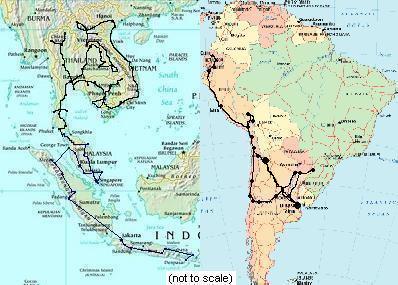
Track where we have been!
Monday, 30 June 2008

Sunday, 22 June 2008
Following the Mekong through Thailand!
Since our last entry we have been exploring north eastern thailand, an area known as Isan, where there are relatively few tourists. We did a loop of the area heading from the Nakhon Ratchasima north to Nong Khai, at the Laos border. From Nong Khai we followed the Mekong River back down stopping in a few small towns along the way (Nakhon Phanom, That Phanom, and Ubon Ratchathani).
Isan has quite a different feel from Bangkok and places in the south of Thailand, being off the tourist trail a bit. Foreigners stick out a bit more, and people seem more friendly. Each town seems smaller and quieter than the last, although they all seem to have a clean, modern "Tesco Lotus" superstore on the outskirts selling everything from bikes to shampoo. (Now that you can cross into Lao by bridge at Nong Khai the Lao locals cross to buy their goods at Nong Khai's Tesco.)
The highlights include:
* From Nakhon Ratchasima, exploring the Khmer style ruins in nearby Phimai and a local silk factory.
* Seeing endless rice paddies in all directions.
* Staying in a guesthouse in Nong Khai on the banks of the Mekong river looking across to Lao a couple of hundred metres away.
* Wandering through a scrupture park in Nong Khai with hundreds of tall statues of weird adaptions of hindu and buddhist figures (some as tall as 10metres).
* Hiring a bicycle and exploring the countryside and local villages near Nong Khai.
* Reaching the small town of Nakhon Phanom and realising that we'd been there 30mins and seen everything.
* Being stranded in a small town near That Phanom with almost no public transport and then being given a lift by a friendly local.
* Mistaking the police station in That Phanom for a public toilet (it did look quite plain outside and had no signs).
* Being surprised by an elephant right out front of an internet cafe, which we paid a small amount to feed.
We finished up in Ubon Ratchathani (the provincial capital) for a dose of "city life" (a relative term) before heading across the border today to Pakse in southern Laos. So far Pakse, the capital of Southern Laos, feels like a smaller town yet than the ones in Isan. We went to the "Shopping centre" which turned out to be a three storey open air building, with escalators to take you to the top two empty floors. The real action is outside where you can buy fruit and bottled water.
Isan has quite a different feel from Bangkok and places in the south of Thailand, being off the tourist trail a bit. Foreigners stick out a bit more, and people seem more friendly. Each town seems smaller and quieter than the last, although they all seem to have a clean, modern "Tesco Lotus" superstore on the outskirts selling everything from bikes to shampoo. (Now that you can cross into Lao by bridge at Nong Khai the Lao locals cross to buy their goods at Nong Khai's Tesco.)
The highlights include:
* From Nakhon Ratchasima, exploring the Khmer style ruins in nearby Phimai and a local silk factory.
* Seeing endless rice paddies in all directions.
* Staying in a guesthouse in Nong Khai on the banks of the Mekong river looking across to Lao a couple of hundred metres away.
* Wandering through a scrupture park in Nong Khai with hundreds of tall statues of weird adaptions of hindu and buddhist figures (some as tall as 10metres).
* Hiring a bicycle and exploring the countryside and local villages near Nong Khai.
* Reaching the small town of Nakhon Phanom and realising that we'd been there 30mins and seen everything.
* Being stranded in a small town near That Phanom with almost no public transport and then being given a lift by a friendly local.
* Mistaking the police station in That Phanom for a public toilet (it did look quite plain outside and had no signs).
* Being surprised by an elephant right out front of an internet cafe, which we paid a small amount to feed.
We finished up in Ubon Ratchathani (the provincial capital) for a dose of "city life" (a relative term) before heading across the border today to Pakse in southern Laos. So far Pakse, the capital of Southern Laos, feels like a smaller town yet than the ones in Isan. We went to the "Shopping centre" which turned out to be a three storey open air building, with escalators to take you to the top two empty floors. The real action is outside where you can buy fruit and bottled water.
Tuesday, 17 June 2008
Bangkok
We've spent the last two weeks in Bangkok - a long time we know - but we needed to organise visas for Lao and Vietnam. (In a first so far, doing this ourselves made this cost more and take longer than if we'd used a travel agent.)
The first week was spent in the backpacker filled area of Khao San Road, which was a convenient base for sightseeing through the old area of Bangkok including chinatown, the grand palace & main temples. After seeing the sights in that area of town and getting sick of the backpacker scene we moved to a more downtown district, closer to the more modern areas of Bangkok and the sky train/monorail which made getting around quick and easy. Here we lived a cosmopolitan life surrounded by shopping malls which were all connected to each other above ground, so it was possible to go all day exploring the area without going to ground level or crossing the road. Among other things, here we caught up on our movies going to the cinema four times, and each time standing before the movie with the rest of the patrons out of respect for the king as the Thai national anthem played.
Based where we were we got a good feel for shopping in Bangkok, which ranges from discount weekend markets and pirated DVDs to upmarket chain stores. We found the best bet was to avoid the obviously touristy places like the pirated goods market in the red light district, where sunglasses sell for 3-4 times what you would normally pay at an average street stall. In fact this is a good principle in general. When we were staying in Khao San Rd, we stepped off the street into a side alley a couple of metres wide and before long found ourselves walking alongside locals' cramped homes fronting onto the alley with the TV blaring and washing drying.
It's clear that religion is an important part of daily life here. Apart from the famous temples surrounding the palace, most businesses have a Buddhist shrine and there are larger public ones on most streets, including the major Erawan shrine in downtown Bangkok outside a major shopping mall which was most of the time surrounded by local Thai. The major shrines have local support businesses springing off them, making and selling gifts for worshippers to give to the shrine.
Getting around Bangkok was pretty easy in general although the buses were sometimes a challenge - you have to watch your map so you know when the bus heads off in a different direction than where you want to go, because the route map you have is old. The modern skytrain system takes these hassles away avoiding the roads altogether and is quick, although you pay for the convenience. We've timed it - a 30 minute walk in one direction was a 3 minute skytrain trip back.
Having lots of tourists around, Bangkok is known for its scams. The most common one is where you're approached by someone who says where you're going is closed, but can take you somewhere else for a bargain fare. There's usually a stop at a silver shop on the way (if you get to your new destination at all) where you get the heavy selling pressure - with commissions paying for your trip. We were on the lookout to have someone try this one but didn't get it until the end of our stay. Unluckily for them, the shrine we were heading to was the one just outside a major mall, fronting on a corner of a busy intersection - it can't be closed! Earlier on though we'd had someone try kind of the reverse idea with us as we were sitting outside a temple. He approached us saying he worked at the temple, made some idle chit chat, then mentioned a temple that was only opened today - because it was Sunday. He said we should look out for yellow tuk-tuks, which are subsidised by the government and a bargain at 10-20 baht. We said thanks, we might visit it next Sunday. Then it turned out the temple was only open once a year. This was a bit suspicious but he walked off quite happy without asking for anything. It all became clear when a few minutes later a tuk tuk driver walked up and offered us a tour to this temple, for a bargain 20 baht in his yellow tuk tuk. He was disappointed when we turned him down, no doubt after getting an encouraging impression from his friend, who we were quite polite to.
The heat is the major challenge in Bangkok, seeming hotter than other places we've been. We reguarly went through 3L of water while sightseeing before 10.30am. It's not so bad in the early morning and evening, when the locals do their Tai Chi and aerobics in Lumphini park in the middle of the city.
By the end of our two weeks we had finished with the main tourist attractions and went to the forensic pathology museum, part of a local hospital. This was one of the most unusual things we've seen on our trip. On display you can see rows of skulls with bullet holes in them, the preserved body of a serial killer, and the bloodied clothing of someone who was stabbed to death. While we were there, the thunderstorm going on outside added to the atmosphere.
The first week was spent in the backpacker filled area of Khao San Road, which was a convenient base for sightseeing through the old area of Bangkok including chinatown, the grand palace & main temples. After seeing the sights in that area of town and getting sick of the backpacker scene we moved to a more downtown district, closer to the more modern areas of Bangkok and the sky train/monorail which made getting around quick and easy. Here we lived a cosmopolitan life surrounded by shopping malls which were all connected to each other above ground, so it was possible to go all day exploring the area without going to ground level or crossing the road. Among other things, here we caught up on our movies going to the cinema four times, and each time standing before the movie with the rest of the patrons out of respect for the king as the Thai national anthem played.
Based where we were we got a good feel for shopping in Bangkok, which ranges from discount weekend markets and pirated DVDs to upmarket chain stores. We found the best bet was to avoid the obviously touristy places like the pirated goods market in the red light district, where sunglasses sell for 3-4 times what you would normally pay at an average street stall. In fact this is a good principle in general. When we were staying in Khao San Rd, we stepped off the street into a side alley a couple of metres wide and before long found ourselves walking alongside locals' cramped homes fronting onto the alley with the TV blaring and washing drying.
It's clear that religion is an important part of daily life here. Apart from the famous temples surrounding the palace, most businesses have a Buddhist shrine and there are larger public ones on most streets, including the major Erawan shrine in downtown Bangkok outside a major shopping mall which was most of the time surrounded by local Thai. The major shrines have local support businesses springing off them, making and selling gifts for worshippers to give to the shrine.
Getting around Bangkok was pretty easy in general although the buses were sometimes a challenge - you have to watch your map so you know when the bus heads off in a different direction than where you want to go, because the route map you have is old. The modern skytrain system takes these hassles away avoiding the roads altogether and is quick, although you pay for the convenience. We've timed it - a 30 minute walk in one direction was a 3 minute skytrain trip back.
Having lots of tourists around, Bangkok is known for its scams. The most common one is where you're approached by someone who says where you're going is closed, but can take you somewhere else for a bargain fare. There's usually a stop at a silver shop on the way (if you get to your new destination at all) where you get the heavy selling pressure - with commissions paying for your trip. We were on the lookout to have someone try this one but didn't get it until the end of our stay. Unluckily for them, the shrine we were heading to was the one just outside a major mall, fronting on a corner of a busy intersection - it can't be closed! Earlier on though we'd had someone try kind of the reverse idea with us as we were sitting outside a temple. He approached us saying he worked at the temple, made some idle chit chat, then mentioned a temple that was only opened today - because it was Sunday. He said we should look out for yellow tuk-tuks, which are subsidised by the government and a bargain at 10-20 baht. We said thanks, we might visit it next Sunday. Then it turned out the temple was only open once a year. This was a bit suspicious but he walked off quite happy without asking for anything. It all became clear when a few minutes later a tuk tuk driver walked up and offered us a tour to this temple, for a bargain 20 baht in his yellow tuk tuk. He was disappointed when we turned him down, no doubt after getting an encouraging impression from his friend, who we were quite polite to.
The heat is the major challenge in Bangkok, seeming hotter than other places we've been. We reguarly went through 3L of water while sightseeing before 10.30am. It's not so bad in the early morning and evening, when the locals do their Tai Chi and aerobics in Lumphini park in the middle of the city.
By the end of our two weeks we had finished with the main tourist attractions and went to the forensic pathology museum, part of a local hospital. This was one of the most unusual things we've seen on our trip. On display you can see rows of skulls with bullet holes in them, the preserved body of a serial killer, and the bloodied clothing of someone who was stabbed to death. While we were there, the thunderstorm going on outside added to the atmosphere.
Subscribe to:
Posts (Atom)