We left Malaysia by train from Alor Setar traveling to the small city of Hat Yai. As soon as we crossed into Thailand we noticed the differences mostly the language (not being about to read signs) and the way people dress. Although the scenery is much the same as north Malaysia - lots of rice paddies and limestone formations.
On arriving in Hat Yai we joined the queue of western tourists waiting at the ATM just inside the train station (convenient). The queue turned out to be quite helpful as we met an English couple heading in the same direction (to Krabi). So we joined up with them and went in search of the local bus station - though we didn't actually get very far when we were approached by a tout for the local "bus" company (actually turned out to be a minivan service). We took the offer from the second company he took us to.
We spent the night in Krabi and then the following morning took a long tail boat to Hat Rai Leh, a mainland beach with no road access. We ended up only staying one night due to the weather not being the greatest. But the beach is surrounded by massive limestone cliffs, which look impressive and were worth the effort and expense to see (You can see why the area is renowned for its rock climbing).
From Krabi we went to a small southern town called Nakhom Si Thammarat. It was a town with the largest Buddhist temple in Southern Thailand (Wat Phra Mahathat) and a national museum with a surprisingly good exhibit about daily life and customs in Thailand. It was interesting visiting our first temple in Thailand which was also incredibly busy - there were hundreds of people giving offerings and worshiping the stupa and buddha images.
We'd heard before arriving in Thailand that Thai people were really friendly and so far it is very true. Everyone smiles at you and makes you feel welcome. Kristal had a strange experience with one friendly Thai teenage boy - whilst she was sitting waiting for Nic to get dinner this friendly boy starting asking her lots of questions and complimenting her - flattering but strange.
So far in Thailand we've found the bus system rather confusing. We had thought getting to Chumphon from Nakhom Si Thammarat would be easy - as we had gone to the bus station the day before to check that buses go to that town. After being assured they did and being told to come back tomorrow to buy tickets we were happy, however, on arriving at the ticket window #3 (as we were told) the kind gentlemen told us no buses go to Chumphon - meaning we had to first catch a bus to Surat Thani, only then to find out that no buses were going to Chumphon from there either - luckily we were able to switch to a train (that actually started in Nakhom Si Thammarat). It was a very long, exhausting and uncomfortable day of long hot waits and travelling.
We spent the night in Chumphon and the next morning took a ferry to the small island of Ko Tao, 1 of 3 islands off the east coast of southern Thailand. One is expensive, the other is legendary for its full moon party - which was actually on that night so we decided to go to Ko Tao where we were able to stay on a secluded beach away from the backpacker strip with good snorkeling just offshore. On arriving in Ko Tao we step off the boat onto a rickety floating platform connected to a rickety wooden pier and were instantly surrounded by touts offering taxi rides, dive courses and accommodation - we considered taking up the taxi offer but declined once the drive put up the price because we wanted to stop at the shop first.
We ended up spending 5 days in Ko Tao to recover from the hectic travelling through northern Malaysia up through Thailand. It was good to be able to get up and not catch a bus or a boat for a change. We found a nice little bungalow almost on the beach that was a step up from our normal accommodation and a good base for our activities (or lack of activities). After this time of solid rest and snorkelling we headed back to Chumphon... see next post for details of the following days activities.
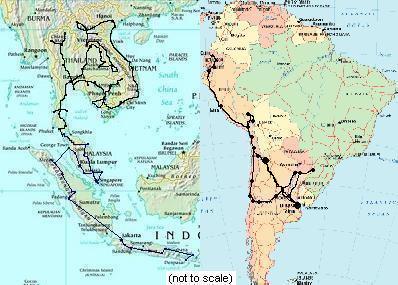
Track where we have been!
Thursday, 29 May 2008

A day in the life....
Feel free to skip this post if details bore you. We know some of you are interested in the daily issues that come up, and we hope both of you enjoy this.
5.15am: We wake up in our guesthouse in Chumphon, Southern Thailand, pack up our things and go into the common area to wait for the minivan that's taking us to Myanmar. We're going as a "Visa run" - not a shopping spree, but just to leave Thailand and come back in again to get another 30 day allowance on our passports. It's cheaper to do it this way than pay for a 10-day extension (about US$60 per person). The tourist minivan is a bit extravagant but the route from Chumphon isn't well serviced by buses and it'd probably take us two days to get there and back ourselves. With the minivan, we expect to be back by lunchtime.
5.45am: The minivan arrives, with some other tourists already on board. Before we leave, the driver calls all the able bodied men to help push his friend's bus to get it started - apparently he left the lights on overnight.
6.00am: Leaving town for the border city of Ranong, about 120km to the southwest of Chumphon, we pass monks young and old collecting alms at dawn, from locals who give a small prayer as well as a donation.
8.00am: Arrive in Ranong. We're asked to make copies of our passports for the driver (presumably so he knows all the tourists to collect before he leaves). We go through the Thai border checkpoint then give our passports and US$10 entry fee for the Myanmar side to the driver. One girl is having trouble with a US$50 note that's too crumpled to be accepted, and the organiser is saying that she can pay in Thai Baht (for the equivalent of $15). We swap some US dollars for Baht with her at a more reasonable rate.
9.00am: We hop into a boat that will take us across the river to Myanmar. It's about a half hour trip, past border outposts and lighthouses that might be there to light up smugglers or refugees. As we approach Myanmar each hill has a golden temple or shrine at the top.
 9.30am: Arrive at the city of Kawthuang in Myanmar. Helping hands from tidily dressed locals reach down to help us out of the boat. They then ask if we want to buy anything from cigarettes to opium. Everything is cheap because of the cyclone. They're very friendly and not too pushy, which is nice for a change. We head into the immigration area where our trip organiser helps the officials by stamping our passports. We each get our photo taken then we're ushered back to the boat. One of the locals insists we take a small currency note as a souvenir - very friendly. Nic is slightly worried it could be a scam where it turns out to be illegal to take money out of the country and he reports us then shares in the huge fine we have to pay. But the trip organiser says its ok and he turns out to be right. Overall just a small glimpse of Myanmar but it looks very interesting.

10.30am: Arrive back at Ranong and we clear the Thai immigration point receiving our new passport stamps. We grab some sticks of chicken and fried eggs from a food vendor (10 baht each, US$0.30) and pile back into the minivan.
12.30pm: Back at the "Farang Bar", our guesthouse in Chumphon. We book some bus tickets on to Hua Hin (270 baht each, US$9), our next destination, leaving at 1pm. It would have been cheaper to book through the bus station rather than the guesthouse, but in Chumphon that's 16km out of town. We order some quick lunch and much needed coffee (170B, US$6). The Guesthouse food is relatively bland and expensive but we don't have much time.
 1pm: A driver shows up at the guesthouse and takes us a few blocks to a bus stop. 20 minutes later the bus turns up. Kristal goes to grab 2 seats together amid the rush of Thai people while Nic puts the luggage below. On the trip we are serenaded by a tweeting bird which someone has brought on in a cage.
5.30pm: Arrive in Hua Hin. We look at the map in our guidebook to figure out where we are - guesthouses near the beach are 600m away. Hua Hin is a beach resort town popular with foreigners and weekenders from Bangkok but we've arrived on a Monday, so we don't expect any difficulty. We set off on foot, ignoring the taxi and guesthouse touts who approach us as a matter of course. A chubby german man pulls up on a motorbike looking like Sergeant Shultz from Hogan's Heroes in his WWII style bike helmet (the helmets all look like that here). He pulls out some laminated photos of his new guesthouse and offers us a discount, but it's still a bit expensive for us.
The rooms in the first guesthouse are small and dingy. Upstairs is apparently better with a view, but they turn out to be just small and dingy with a view. We say we'll look at another place and the manager offers us a 10% discount for two nights. We thank her and say we may come back.
The second guesthouse is a bit tidier and has a nice deck area facing the sea, with a similar price as the first (400B, US$13 per night), so we take it. We politely ask if there's a discount for 2-3 nights paid in advance. No luck: we should have asked before we took the room. Never mind.

 6:45pm: We head into town to find food. Very hungry. There are many steak and seafood restaurants, tailors and condo developments for sale. Clearly a tourist spot. We find some Thai noodles and curry in the night market (65B, US$2).
8.00pm: Back to the guesthouse to unpack a bit and have an early night. Plan to find the beach tomorrow - it looks quite close on the map but we haven't actually seen it yet.
5.15am: We wake up in our guesthouse in Chumphon, Southern Thailand, pack up our things and go into the common area to wait for the minivan that's taking us to Myanmar. We're going as a "Visa run" - not a shopping spree, but just to leave Thailand and come back in again to get another 30 day allowance on our passports. It's cheaper to do it this way than pay for a 10-day extension (about US$60 per person). The tourist minivan is a bit extravagant but the route from Chumphon isn't well serviced by buses and it'd probably take us two days to get there and back ourselves. With the minivan, we expect to be back by lunchtime.
5.45am: The minivan arrives, with some other tourists already on board. Before we leave, the driver calls all the able bodied men to help push his friend's bus to get it started - apparently he left the lights on overnight.
6.00am: Leaving town for the border city of Ranong, about 120km to the southwest of Chumphon, we pass monks young and old collecting alms at dawn, from locals who give a small prayer as well as a donation.
8.00am: Arrive in Ranong. We're asked to make copies of our passports for the driver (presumably so he knows all the tourists to collect before he leaves). We go through the Thai border checkpoint then give our passports and US$10 entry fee for the Myanmar side to the driver. One girl is having trouble with a US$50 note that's too crumpled to be accepted, and the organiser is saying that she can pay in Thai Baht (for the equivalent of $15). We swap some US dollars for Baht with her at a more reasonable rate.
9.00am: We hop into a boat that will take us across the river to Myanmar. It's about a half hour trip, past border outposts and lighthouses that might be there to light up smugglers or refugees. As we approach Myanmar each hill has a golden temple or shrine at the top.
 9.30am: Arrive at the city of Kawthuang in Myanmar. Helping hands from tidily dressed locals reach down to help us out of the boat. They then ask if we want to buy anything from cigarettes to opium. Everything is cheap because of the cyclone. They're very friendly and not too pushy, which is nice for a change. We head into the immigration area where our trip organiser helps the officials by stamping our passports. We each get our photo taken then we're ushered back to the boat. One of the locals insists we take a small currency note as a souvenir - very friendly. Nic is slightly worried it could be a scam where it turns out to be illegal to take money out of the country and he reports us then shares in the huge fine we have to pay. But the trip organiser says its ok and he turns out to be right. Overall just a small glimpse of Myanmar but it looks very interesting.
10.30am: Arrive back at Ranong and we clear the Thai immigration point receiving our new passport stamps. We grab some sticks of chicken and fried eggs from a food vendor (10 baht each, US$0.30) and pile back into the minivan.
12.30pm: Back at the "Farang Bar", our guesthouse in Chumphon. We book some bus tickets on to Hua Hin (270 baht each, US$9), our next destination, leaving at 1pm. It would have been cheaper to book through the bus station rather than the guesthouse, but in Chumphon that's 16km out of town. We order some quick lunch and much needed coffee (170B, US$6). The Guesthouse food is relatively bland and expensive but we don't have much time.
 1pm: A driver shows up at the guesthouse and takes us a few blocks to a bus stop. 20 minutes later the bus turns up. Kristal goes to grab 2 seats together amid the rush of Thai people while Nic puts the luggage below. On the trip we are serenaded by a tweeting bird which someone has brought on in a cage.
5.30pm: Arrive in Hua Hin. We look at the map in our guidebook to figure out where we are - guesthouses near the beach are 600m away. Hua Hin is a beach resort town popular with foreigners and weekenders from Bangkok but we've arrived on a Monday, so we don't expect any difficulty. We set off on foot, ignoring the taxi and guesthouse touts who approach us as a matter of course. A chubby german man pulls up on a motorbike looking like Sergeant Shultz from Hogan's Heroes in his WWII style bike helmet (the helmets all look like that here). He pulls out some laminated photos of his new guesthouse and offers us a discount, but it's still a bit expensive for us.
The rooms in the first guesthouse are small and dingy. Upstairs is apparently better with a view, but they turn out to be just small and dingy with a view. We say we'll look at another place and the manager offers us a 10% discount for two nights. We thank her and say we may come back.
The second guesthouse is a bit tidier and has a nice deck area facing the sea, with a similar price as the first (400B, US$13 per night), so we take it. We politely ask if there's a discount for 2-3 nights paid in advance. No luck: we should have asked before we took the room. Never mind.

 6:45pm: We head into town to find food. Very hungry. There are many steak and seafood restaurants, tailors and condo developments for sale. Clearly a tourist spot. We find some Thai noodles and curry in the night market (65B, US$2).
8.00pm: Back to the guesthouse to unpack a bit and have an early night. Plan to find the beach tomorrow - it looks quite close on the map but we haven't actually seen it yet.
Tuesday, 13 May 2008
From the middle of the Jungle, To lying on a tropical beach...
Having arrived back in Malaysia we aimed for the Taman Negara national park, in an area of jungle that fills up central Malaysia. The main attraction of Taman Negara is, surprise surprise, being in the jungle. We picked a place to stay on the edge of town which meant there was more wildlife around - including waking up to the birds in the early morning, watching out to make sure you don't step on frogs on the footpath after the rain, and rescuing a mouse who had fallen into our toilet one night. We found him there in the morning, paddling frantically to keep his nose
above water.
There are many day-trip walks you can do in the national park and it was interesting to walk along the paths keeping an eye out for the wild pigs and large lizards that scurry out of your way. (The lizards aren't very clever - when they see you they move a bit then try to hide by staying still. But by moving they show you where they are, so staying still after that seems a bit pointless.)
There were two main highlights, one being the canopy walk, a wooden/rope bridge suspended 50m above the forest floor, so you can walk amongst the treetops. It seems rickety when you're up there but really it's not that bad. The other was staying overnight at a "hide" in the jungle. A "hide" is like a tramping hut built overlooking a clearing so you can hide there and watch for the animals that come out. Ours was rustic to say the least. But after picking the only bunk without a wasp nest underneath it and scaring away the huge spider we settled down to watching. The only animals we saw were two "barking deer" who came to drink from stream overlooked by the hide. They had very good hearing - the first one heard us when we softly stood up to get a better view, even though we were about 20m away. After a little bit he galloped away, barking. Sleeping in the pitch black amidst the jungle noises was interesting and later on in the night there was some loud rustling that came from below the hide where we'd tipped out our leftover takeaway fried rice. In the morning a bat helped us get up by flying around the inside of the hide.
Leaving the jungle was a mammoth travel day, starting at 7.30am with a 20 minute walk from our hide back to the river, then shuttled by boat which we had arranged the day before back to civilisation, then a 1.5hr bus ride out of the national park, then a 7hr train ride on the "jungle train" through central Malaysia to Kota Bharu in north-east Malaysia on our way to the Perhentian Islands.
The islands were the closest we've come so far (except Bali) to a real tourist spot. Development hasn't kept up with tourist numbers so prices are high and service levels relatively low. Far from a shopkeeper or restauranteur welcoming you into his store as you walk past, we usually had to work to get the locals to pay attention to us once we were in. There's little competition so where else are you going to go? But once you get over that, food prices being 3 times normal, and eating dinner early if you want to avoid a 45 minute wait, it's easy to get into the beach lifestyle. The one thing the islands had in common with the jungle was the wildlife - seeing 2m long lizards sunbathing just off the beach, and snorkelling with sea turtles, stingray and 1.5m long black-tipped sharks (friendly ones, according to the guide).
We're now trying to get into Thailand - we say trying because we want to enter Thailand from western Malaysia (the east side of Southern Thailand has some safety issues for travellers) and the route from east to west across northern Malaysia doesn't have all that many buses. Still, we hope to arrive on the west coast tomorrow which will be more or less where we entered Malaysia six weeks ago, and head up into southern Thailand the next day.
above water.
There are many day-trip walks you can do in the national park and it was interesting to walk along the paths keeping an eye out for the wild pigs and large lizards that scurry out of your way. (The lizards aren't very clever - when they see you they move a bit then try to hide by staying still. But by moving they show you where they are, so staying still after that seems a bit pointless.)
There were two main highlights, one being the canopy walk, a wooden/rope bridge suspended 50m above the forest floor, so you can walk amongst the treetops. It seems rickety when you're up there but really it's not that bad. The other was staying overnight at a "hide" in the jungle. A "hide" is like a tramping hut built overlooking a clearing so you can hide there and watch for the animals that come out. Ours was rustic to say the least. But after picking the only bunk without a wasp nest underneath it and scaring away the huge spider we settled down to watching. The only animals we saw were two "barking deer" who came to drink from stream overlooked by the hide. They had very good hearing - the first one heard us when we softly stood up to get a better view, even though we were about 20m away. After a little bit he galloped away, barking. Sleeping in the pitch black amidst the jungle noises was interesting and later on in the night there was some loud rustling that came from below the hide where we'd tipped out our leftover takeaway fried rice. In the morning a bat helped us get up by flying around the inside of the hide.
Leaving the jungle was a mammoth travel day, starting at 7.30am with a 20 minute walk from our hide back to the river, then shuttled by boat which we had arranged the day before back to civilisation, then a 1.5hr bus ride out of the national park, then a 7hr train ride on the "jungle train" through central Malaysia to Kota Bharu in north-east Malaysia on our way to the Perhentian Islands.
The islands were the closest we've come so far (except Bali) to a real tourist spot. Development hasn't kept up with tourist numbers so prices are high and service levels relatively low. Far from a shopkeeper or restauranteur welcoming you into his store as you walk past, we usually had to work to get the locals to pay attention to us once we were in. There's little competition so where else are you going to go? But once you get over that, food prices being 3 times normal, and eating dinner early if you want to avoid a 45 minute wait, it's easy to get into the beach lifestyle. The one thing the islands had in common with the jungle was the wildlife - seeing 2m long lizards sunbathing just off the beach, and snorkelling with sea turtles, stingray and 1.5m long black-tipped sharks (friendly ones, according to the guide).
We're now trying to get into Thailand - we say trying because we want to enter Thailand from western Malaysia (the east side of Southern Thailand has some safety issues for travellers) and the route from east to west across northern Malaysia doesn't have all that many buses. Still, we hope to arrive on the west coast tomorrow which will be more or less where we entered Malaysia six weeks ago, and head up into southern Thailand the next day.
Wednesday, 7 May 2008
A week in Singapore...
We entered Singapore by bus from Malaysia, over the 1km-long causeway bridge that separates the two countries. With the border formalities relatively simple, many people cross over on shopping trips and the causeway seems in a perpetual state of gridlock.
Singapore is for many practical purposes like a western city - clean and efficient with modern facilities, as well as western prices. There are about 4 million people crammed into an area less than greater Auckland, which means that the island is pretty much covered in apartments and housing development blocks, although being the well-organised city that it is there are also many green areas and parks scattered around.
The culture of the city remains eastern and multi-ethnic with a mix of Chinese, Indian, and Malay residents as well as a relatively small ex-pat community. Despite this the main language is english (with some local variations, known as "singlish"). Many people seem to eat their meals out at hawker stalls / foodcourts and spend relatively little time at home.
We were able to experience a different side of Singapore, staying with a friend of Kristal's (thanks, Amy) in "landed property" - a house, which is quite unusual in Singapore. The "landed" bit consisted of the carport, and a sliver of lawn. It was great to stay like a local for a change.
We spent our days doing the touristy things that stand out in a city like Singapore. The main highlights were:
- The zoo, which is meant to be world class and includes white tigers, polar bears and probiscus monkeys (which look like old men with their big noses and small eyes). Click here for a picture.
- The "theme-park" island of Sentosa, complete with resorts, artificial beaches and a range of pricey tourist activities. We went to underwaterworld on the island where you can touch some of the sharks and stingrays, and saw a pink dolphin show.
- The Changi prison museum, quite a personal display of local accounts from the Japanese occupation of Singapore during the second world war.
- Ironically, the first snake we've seen in asia was in Singapore at the national park which is surprisingly large. (What do you do when you see a snake? - according to Nic and Amy, you grab your camera.)
- Our stay wouldn't have been complete without a drink at the famous Raffles Hotel (named after Stamford Raffles, the founder of Singapore). The hotel is like an island of colonial atmosphere in the middle of the CBD.
We left Singapore the same way we entered, back into Malaysia by bus, heading north towards Thailand. It was interesting to arrive back in Malaysia where everything seems ramshackle in comparison, but is itself clean and organised compared to Indonesia.
Singapore is for many practical purposes like a western city - clean and efficient with modern facilities, as well as western prices. There are about 4 million people crammed into an area less than greater Auckland, which means that the island is pretty much covered in apartments and housing development blocks, although being the well-organised city that it is there are also many green areas and parks scattered around.
The culture of the city remains eastern and multi-ethnic with a mix of Chinese, Indian, and Malay residents as well as a relatively small ex-pat community. Despite this the main language is english (with some local variations, known as "singlish"). Many people seem to eat their meals out at hawker stalls / foodcourts and spend relatively little time at home.
We were able to experience a different side of Singapore, staying with a friend of Kristal's (thanks, Amy) in "landed property" - a house, which is quite unusual in Singapore. The "landed" bit consisted of the carport, and a sliver of lawn. It was great to stay like a local for a change.
We spent our days doing the touristy things that stand out in a city like Singapore. The main highlights were:
- The zoo, which is meant to be world class and includes white tigers, polar bears and probiscus monkeys (which look like old men with their big noses and small eyes). Click here for a picture.

- The "theme-park" island of Sentosa, complete with resorts, artificial beaches and a range of pricey tourist activities. We went to underwaterworld on the island where you can touch some of the sharks and stingrays, and saw a pink dolphin show.
- The Changi prison museum, quite a personal display of local accounts from the Japanese occupation of Singapore during the second world war.
- Ironically, the first snake we've seen in asia was in Singapore at the national park which is surprisingly large. (What do you do when you see a snake? - according to Nic and Amy, you grab your camera.)
- Our stay wouldn't have been complete without a drink at the famous Raffles Hotel (named after Stamford Raffles, the founder of Singapore). The hotel is like an island of colonial atmosphere in the middle of the CBD.
We left Singapore the same way we entered, back into Malaysia by bus, heading north towards Thailand. It was interesting to arrive back in Malaysia where everything seems ramshackle in comparison, but is itself clean and organised compared to Indonesia.
Subscribe to:
Posts (Atom)