Well we know its been a while since we've add a new post - sorry if anyone was starting to worry about where or what we are up to.
Since the last post we've actually been to a few places - Kuala Lumpur, Melaka and Tioman Island. The blog entry could be quite long if we went into detail about each so we'll just give you the main highlights.
Kuala Lumpur (KL):
* Travelling in luxury buses with seats like lazy boy chairs
* Staying in a renovated 1930's "Grocers Association" building / hostel right in the middle of Chinatown, and watching the local stall-owners set up their little shops each morning
* Finally for Kristal getting the all healed and ok on the ear infection front
* Getting to grips with bargaining in Malaysia - though we still think we don't quite have the hang of it yet, with stall-owners being more sticky with their prices than in Indonesia
* Experiencing Petaling Street (Chinatown's Street Market) - with pirated DVDs, designer handbags, and designer clothing stalls cramming the street
* Exploring the many huge shopping malls dotted around the city
* Visiting the Petronas Twin Towers (with 3D intro movie explaining how great the state-owned Petronas company is - what's sadder is that one tourist took a video of it on his phone) and checking out the view from the 41st floor sky bridge. Not to forget the 1 and 1/2 hour wait for tickets first thing in the morning
* Exploring a traditional Malay house
* Visiting yet another muesum with a pro-country and government spin on the exhibit
* Wandering around the expat suburb with the specialist expat furniture rental store, which is actually called "the expat furniture rental store"
Melaka:
* A big difference to KL, with the town itself being smaller and also more historical, having been used as a major trading post first under Malay rule, before been conquered by the Dutch, then later handed over to the English
* Experiencing the feeling of being in a city of two towns - there is quite a distinct difference between the bustling modern areas and historical town centre with the small town vibe
* Being overwhelmed by the amount of tourists and tourist buses that cram up the attractions - realising if there wasn't so many tourist the church ruins would have had a totally different feel (There were approximately 30 chattering tourists, a busker, numerous souvenir stalls and cameras flashing everywhere.)
* Trying the local cuisine - chicken & rice balls, pineapple nonya tarts and satay restaurant with a boiling bubbling pot of satay sauce you cook your food in (Imagine Satay Fondue).
* Experiencing Chinatown night market with delicious lime prune juice, open air karaoke and line dancing in the Chinese Clan Houses to american country music tunes.
Tioman Island - a jungle/tropical island off Malaysia's east coast:
* Not falling for the tourist scam - where the bus drops you at the travel agent and tries to tell you there is hardly any accommodation on the island and that you should book there - at what turns out to be 2 or 3 times the normal price. All the other tourists on our bus fell for this. Don't they read their guidebooks?
* Staying in a beach front bungalow - it was such a perfect location where you can listen and see the ocean lapping at the shore and the numerous animals wandering by.
* Getting to snorkel once again in the gorgeous clear water with beautiful fish and coral, we even got to see a few stingrays and sea anemones and their clownfish.
* Enjoying the duty free store at the main village on the island. We're not sure how it's meant to work but no-one asked us for any ID or tickets, or seemed to mind us stocking up on beer to take back to our bungalow.
Even though we have lacked updates we've still been uploading photos for you all to enjoy so make sure to check them out. We're now in Singapore and will endeavour to add another update shortly.
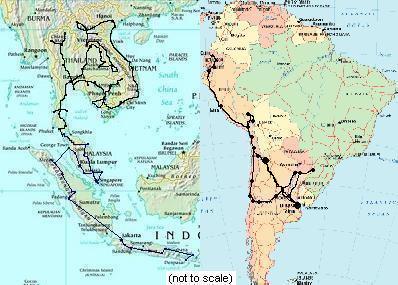
Track where we have been!
Sunday, 27 April 2008

Sunday, 13 April 2008
First steps in Malaysia - Penang & Cameron Highlands
Penang, and Malaysia in general, is very different to Indonesia we have found.
The island of Penang and its main city of Georgetown have an english colonial feel, having been founded as a trading centre for the english East India Company. The streets are named after prominent englishmen of the day, and like elsewhere in Malaysia, english is commonly spoken by the locals. Fort Cornwallis, the defensive establishment built by the East India Company, is still a prominent tourist attraction.
However, this doesn't detract from the oriental culture of the place. As the island's importance as a trading post grew it attracted Malay immigrants, Indians, Chinese and Acehnese from North Sumatra. The city of Georgetown has distinct areas such as Chinatown and Little India reflecting the local cultures, food and architechtural styles, while the CBD is built up with the latest modern touches.

Our hostel was in Chinatown, in "Love Lane", a popular street for backpackers hostels, not so named because of its trendy, romantic location. We ended up spending a week in Penang while Kristal recovered from a cold, which gave us plenty of time to check out the local ethnic restaurants and sample the Indian curries served on banana tree leaves.
From Penang we headed south and inland to the Cameron Highlands, a hill station area which was only populated within the last 50-60 years, prior to which it was jungle. The trip was interesting as we found that having a common language with the locals can have a downside: our tourist "helper" at the bus station got quite abusive when we found a cheaper route to the one he was promoting, meaning he missed out on his
commission.

The Cameron Highlands have a more temperate climate and so are a popular area for growing vegetables and flowers but also support two large tea plantations. One of the highlights was visiting a "butterfly farm" and one of these plantations. Having already seen one in Indonesia we already knew about the process of making tea but were surprised to learn that here there were only 200 tea-pickers, who use machinery to help in their job, compared to over 2,000 pickers at the plantation in Indonesia who pick the old fashioned way.
Despite being an interesting change from the coast the Cameron Highlands are cold (it must have been less than 20 degrees on some nights) so we didn't stay too long, and are now in Kuala Lumpur where it's a more comfortable 30 degrees on average.
The island of Penang and its main city of Georgetown have an english colonial feel, having been founded as a trading centre for the english East India Company. The streets are named after prominent englishmen of the day, and like elsewhere in Malaysia, english is commonly spoken by the locals. Fort Cornwallis, the defensive establishment built by the East India Company, is still a prominent tourist attraction.
However, this doesn't detract from the oriental culture of the place. As the island's importance as a trading post grew it attracted Malay immigrants, Indians, Chinese and Acehnese from North Sumatra. The city of Georgetown has distinct areas such as Chinatown and Little India reflecting the local cultures, food and architechtural styles, while the CBD is built up with the latest modern touches.

Our hostel was in Chinatown, in "Love Lane", a popular street for backpackers hostels, not so named because of its trendy, romantic location. We ended up spending a week in Penang while Kristal recovered from a cold, which gave us plenty of time to check out the local ethnic restaurants and sample the Indian curries served on banana tree leaves.
From Penang we headed south and inland to the Cameron Highlands, a hill station area which was only populated within the last 50-60 years, prior to which it was jungle. The trip was interesting as we found that having a common language with the locals can have a downside: our tourist "helper" at the bus station got quite abusive when we found a cheaper route to the one he was promoting, meaning he missed out on his
commission.

The Cameron Highlands have a more temperate climate and so are a popular area for growing vegetables and flowers but also support two large tea plantations. One of the highlights was visiting a "butterfly farm" and one of these plantations. Having already seen one in Indonesia we already knew about the process of making tea but were surprised to learn that here there were only 200 tea-pickers, who use machinery to help in their job, compared to over 2,000 pickers at the plantation in Indonesia who pick the old fashioned way.
Despite being an interesting change from the coast the Cameron Highlands are cold (it must have been less than 20 degrees on some nights) so we didn't stay too long, and are now in Kuala Lumpur where it's a more comfortable 30 degrees on average.
Subscribe to:
Posts (Atom)