
Track where we have been!
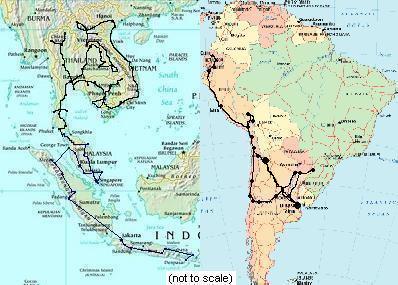
Monday, 29 December 2008
Christmas in Peru!

Thursday, 25 December 2008
Back in Peru, but seeing the sights this time
Entering Peru again we followed the same road south that we had travelled north on about a month earlier, but this time we stopped in more places. Our first real stop was Trujillo, about halfway to Lima, which is a nice city that has long since sprawled beyond the 16 or so blocks within the city walls remaining from when Francisco Pizarro founded the city ages ago. Some accommodations had closed for christmas so we got stuck paying a little more but having some luxuries like our own bathroom and cable TV for a change. Luckily exploring Trujillo doesn´t take very long so we were able to spend a day blobbing out watching movies.


Near Trujillo there are ruined cities of two civilisations, the Moche who lived in the first millenium AD and the Chimu who came after that (and who were taken over by the Incas around AD1500). We saw a Moche temple with partially unearthed murals carved on the inside, and the remains of a large palace complex built by the Chimu.
From Trujillo it was south again to Lima. We have found that getting around in Peru is easy if you want to go to Lima, or are in Lima going somewhere else. But if you´re already somewhere else, and want to go to another place that isn´t Lima, you are in for a bit of work walking around the different bus companies (often there isn´t a central bus station) trying to find a company that will stop to let you off in the town you want to go to, instead of driving straight through. The long distances don´t help, with most trips being 500-1000 km.
We´d already passed through Lima going north, and stayed in the trendy new part of town. This time we stayed in the older city centre, which was mad with the christmas rush. We stayed in a B&B kind of operation run by a local family, who had a christmas tree and decorations all set up. The old city was exactly what we expected with a collection of old churches, plazas and the large presidential palace. We didn´t have very good luck with the museums, as most of the ones we went to were closed, under renovation, or only running tours in spanish that day. But we did find our way almost by accident to an art gallery showing a collection of old italian art including lots of things by Salvador Dali and the famous The Thinker sculpture of the man with his head resting on his fist. We also stumbled upon a strange art exhibit that featured potatoes in every painting and scuplture, odd but fitting for a country with over 100 types of potatoes. Lima has an interesting monastery with old burial chambers containing the bones of about 25,000 people, which you can see on a tour.
South of Lima we found ourselves on a clear tourist trail taking in first the Ballestas Islands, near the town of Pisco, which are home to sea lions, pelicans, penguins and all sorts of other wildlife. Kind of a substitute for Ecuador´s Galapagos islands, for those on a budget. Also near Pisco is a giant image of a candleabra in a desert hill, for which no-one knows the origin. There are theories ranging from it being a Masonic symbol constructed by General San Martin at the time of the liberation of Peru, to it being the last remnant of an ancient culture.
More ancient symbols are to be found in the desert at Nasca, further south, where there are huge images and geometric shapes etched into the desert. The best (although most expensive) way to appreciate them is from the air, and the process of buying tickets is an adventure if you want to get the best deal. The formations at Nasca are surrounded by mystery with questions such as why would a culture make such big images that can only really be seen from above. Aliens, perhaps? Hmmm.
Throughout our time in Pisco and Nasca we kept running into the same people, who were obviously seeing the same sights in the same order. One American man was on our Islas Ballestas tour, our bus from Pisco to Nasca, and we also ran into him at the airport in Nasca. After we checked out of our hostel in Nasca we left our bags with the hostel people in a secure room, and when we came back to collect them we had no trouble - the lady said the room was already open with other tourists getting their stuff, because, as she said, everybody was on the same bus to Arequipa.
Links for the super keen:
Friday, 19 December 2008
Heading back south through Ecuador!
From Quito we headed to the small town of Riobamba, which has beautiful views of the towering Chimborazo Volcano from almost every point in town. We only spent a night in Riobamba, the main reason for coming was to take the famous devils nose train, which starts in Riobamba. It is one of the only passenger trains in operation in Ecuador and not maintained extremely well. The old train broke down a few months ago and now they have buses converted to operate on rails (which go faster). It was a fun train ride, the first time we have ridden on the roof of a train. On this particular train it is actually preferable to sit on the roof due to the view through the windows not being very good. The reason it is called the devils nose is because of the steep valley it descends, going both backwards and forwards over a series of switchbacks. The views from the train were great, especially travelling through the remote villages you do not get to appreciate on buses.
We got off the train in another small town called Alausi, which has no attractions and a suspicious bus timetable. We arrived thinking it would be easy to catch a bus to Cuenca, Ecuadors third largest city, but the only company in town told us that the bus had already left and there was not another one until tomorrow at 10am. Although back at the train station a group of tourists were waiting for the bus organised by some random guy and it turned out was with the same company.
Cuenca is quite a charming city and we spent three days exploring its sites. The highlight would have to be the thursday morning market. The local village women come to town laden with big carry baskets filled with fruits and vegetables and set themselves up along the streets. Cuencas other sights include its many churches and museums, as well as a museum of the famous Panama hats. Next to a picturesque river, the city is filled with lots of colonial archiquetecture and has the feeling of a much smaller Quito.
We left Cuenca a few days ago spending a night in sleepy Loja, further south, before changing to a bus to take us back into the north of Peru.
We got off the train in another small town called Alausi, which has no attractions and a suspicious bus timetable. We arrived thinking it would be easy to catch a bus to Cuenca, Ecuadors third largest city, but the only company in town told us that the bus had already left and there was not another one until tomorrow at 10am. Although back at the train station a group of tourists were waiting for the bus organised by some random guy and it turned out was with the same company.
Cuenca is quite a charming city and we spent three days exploring its sites. The highlight would have to be the thursday morning market. The local village women come to town laden with big carry baskets filled with fruits and vegetables and set themselves up along the streets. Cuencas other sights include its many churches and museums, as well as a museum of the famous Panama hats. Next to a picturesque river, the city is filled with lots of colonial archiquetecture and has the feeling of a much smaller Quito.
We left Cuenca a few days ago spending a night in sleepy Loja, further south, before changing to a bus to take us back into the north of Peru.
Tuesday, 9 December 2008
Exploring the Oriente & Quito!
From Baños we travelled through spectacular scenery. The road from Baños to Puyo (2 hours away) drops dramatically down to a jungle filled valley, with waterfalls shooting out of the cliffs. After Baños our destination was Tena (a further 3 hours from Puyo), and despite being the provincial capital of a very large province, the town was smaller than Baños. There isn´t much to do in Tena but our main reason for stopping was to check out possible jungle trips. It turns out the town doesn´t attract many tourists with the majority of the travel agencies listed in the lonely planet no longer existing. To do a bit more research on jungle trips we went 23km from Tena to an even smaller town, Misahualli, located on the fork of two rivers and backed by jungle. Misahualli is a very charming town and feels perfect for relaxing, with jungle edge roads to walk down and a beach by the river to watch the local troup of monkeys play. However, come night you realise that the perfecting resting location has only expensive food and the water in your hotel has stopped working. So we moved back to Tena the next day and booked ourselves onto a jungle trip for the following day.
On arriving back in Tena we found that there is one attraction in Tena (listed almost no where though), the Parque Amazonas - a small Island on the River that flows through the centre of Tena. It was actually a really interesting park with lots of animals found in the jungle, including a Tapir, Toucans, Mouse deer and monkeys. The park also has a couple of geese, which are not the friendliest, biting Kristal on the butt when her back was turned (maybe Kristal was a little close to their food or maybe Nic got his geese speak a tad wrong).
While on our jungle trip we stayed at Shangrila Lodge about 20km from Tena and the location was amazing, perched on top of a cliff giving sweeping views of the jungle and river below and the hills and volcanoes on the horizon. Absolutely beautiful. Our three days in the jungle were packed with trekking through virgin rainforest and climbing through canyons on the first day, visiting a nearby local Quichua village and tubing downriver on the second day and on the third trekking through primary rainforest, climbing waterfalls and tubing once again. We didn´t see a lot of animals on our treks but the Taratulas we stumbled upon whilst admiring a flying beetle was scary enough. Our three days were really enjoyable and well worth it.

[Our guide, Darwin, with the Taratula]
From Shangrila we heading north to Quito, Ecuadors capital city. Quito is a very long city about 60km long and 13km wide, the reason being it is located in the many valleys in the highlands with big volcanoes on the sides. We arrived in Quito for the last few days of the annual Quito festival, which actually goes for two weeks. It celebrates the founding of the city and there is music and people everywhere. We saw numerous marching bands and party buses. It made for a very hectic feeling welcome to the city.
The weather in Quito is very unpredictable, being in the highlands its common to have sunshine and hail storms within a few hours of each other, as we discovered. The city has a lot of old colonial buildings, narrow streets and gorgeous churches including the Basilica del Voto Nacional, which we climbed up the top of the steeple for awesome views.
Whilst in Quito we went on a day trip to a small town 2 hours north called Otavalo. It is famous for its Saturday Market, which takes up the main plaza and several blocks. It was very big and it is meant to be the biggest hand crafts market in South America. We spent a bit of money on souvenirs, finding it easier to bargain later in the afternoon when people are about to head home.
We leave Quito tomorrow, glad to be moving out of the bustle. We are heading South again, making our way to Riobamba a small town that is the start of an excellent train ride.
Thursday, 27 November 2008
Through Peru...and into Ecuador
We entered Peru via colectivo or shared taxi, arriving in Tacna on the Peruvian side of the border. Border towns are usually a little dodgy so we headed straight through and onto a bus to the bigger city of Arequipa, on the way noticing the large Peruvian military presence near the border and the huge murals on the side of the desert sand dunes. Many of the murals were probably made by the army because they had military and nationalistic themes.
Arequipa is a nice town, at least in the centre where we stayed, with cobblestone streets and colonial buildings surrounding the central plaza. The city has a collection of old churches and an interesting old convent that is a kind of city within a city, with its own community and streets within a walled area. On our arrival we immediately started to ignore the advice of the owner of our last guesthouse in Chile, and look for the places where the locals eat. We weren´t disappointed - there are many local eateries in town selling a set menu for lunch and dinner for around US$1. You get a huge amount of (presumably) traditional Peruvian food, with a soup for the first course followed by a second course with meat, veges and many types of potatoes. The locals were welcoming as we found ourselves waiting with the others at midday for the popular place on our street to open, and an old lady who was also waiting ushered us in when it did.
After a few days in Arequipa to figure out how things work in Peru, we began our big push 2500km north to Ecuador, stopping only for a day in Lima at the halfway point. The APEC meeting was just about to start when we were there, with streets blocked off and police officers all around. We didn´t manage to get the photo of John Key sightseeing on the taxpayer dollar.
Around 20 hours further north and after a change from our first class Peruvian bus to a somewhat less comfortable Ecuadorian one, we crossed into Ecuador. It was here that the coastal desert we´d followed since around Santiago finally ended and we began passing endless banana plantations instead. Occasional small towns were filled with fruit venders, and we bought four mangoes for $1 from one of the many salesmen who jump on the buses whenever they stop for a few minutes. In terms of atmosphere it was like stepping back to Indonesia.
After this introduction we were quite surprised when we arrived in Guayaquil, Ecuador´s largest city, to pull up at a huge modern multi-storey bus station that looked more like an airport. The city itself is quite clean and modern and not at all like the rural areas we´d passed through. There has been some imaginative civic development with the waterfront area, which apparently used to be crime-ridden and a very dangerous place, being transformed into a 3km long promenade with parks, restaurants and food venders, and usually filled with people. Also, someone had the idea to fill the downtown Parque Bolivar with Iguanas that roam around being fed by visitors. You´ll have to see our pictures to believe it (click the link on the blog page).
Being a relatively small country (about the size of NZ, but with 3 times the populaton) getting around is quite easy. Going back to the airport/bus station, we bought a ticket from one of the 100 ticket booths for one of the numerous departures going northeast into the highlands. As we got further away from the coast the scenery became more and more spectacular with hills and volcanoes separated by deep valleys. Late in the day we arrived in Banos, literally ¨bathing place¨or similar, although that´s also what they call the toilets in South America. This small town is all about the hot springs from the volcano that it sits under. Even the church is dedicated to the town´s patron saint ¨The virgin of the holy water¨and is filled with paintings of people being saved from disaster by the saint. The springs make the town a real tourist destination for Ecuadorians and virtually every building in the centre is tourism oriented. Midweek and in the off season, we found the place nice and relatively quiet. The setting, in a valley surrounded by hills and with the volcano somewhere in the clouds, make for a relaxing few days.
Arequipa is a nice town, at least in the centre where we stayed, with cobblestone streets and colonial buildings surrounding the central plaza. The city has a collection of old churches and an interesting old convent that is a kind of city within a city, with its own community and streets within a walled area. On our arrival we immediately started to ignore the advice of the owner of our last guesthouse in Chile, and look for the places where the locals eat. We weren´t disappointed - there are many local eateries in town selling a set menu for lunch and dinner for around US$1. You get a huge amount of (presumably) traditional Peruvian food, with a soup for the first course followed by a second course with meat, veges and many types of potatoes. The locals were welcoming as we found ourselves waiting with the others at midday for the popular place on our street to open, and an old lady who was also waiting ushered us in when it did.
After a few days in Arequipa to figure out how things work in Peru, we began our big push 2500km north to Ecuador, stopping only for a day in Lima at the halfway point. The APEC meeting was just about to start when we were there, with streets blocked off and police officers all around. We didn´t manage to get the photo of John Key sightseeing on the taxpayer dollar.
Around 20 hours further north and after a change from our first class Peruvian bus to a somewhat less comfortable Ecuadorian one, we crossed into Ecuador. It was here that the coastal desert we´d followed since around Santiago finally ended and we began passing endless banana plantations instead. Occasional small towns were filled with fruit venders, and we bought four mangoes for $1 from one of the many salesmen who jump on the buses whenever they stop for a few minutes. In terms of atmosphere it was like stepping back to Indonesia.
After this introduction we were quite surprised when we arrived in Guayaquil, Ecuador´s largest city, to pull up at a huge modern multi-storey bus station that looked more like an airport. The city itself is quite clean and modern and not at all like the rural areas we´d passed through. There has been some imaginative civic development with the waterfront area, which apparently used to be crime-ridden and a very dangerous place, being transformed into a 3km long promenade with parks, restaurants and food venders, and usually filled with people. Also, someone had the idea to fill the downtown Parque Bolivar with Iguanas that roam around being fed by visitors. You´ll have to see our pictures to believe it (click the link on the blog page).
Being a relatively small country (about the size of NZ, but with 3 times the populaton) getting around is quite easy. Going back to the airport/bus station, we bought a ticket from one of the 100 ticket booths for one of the numerous departures going northeast into the highlands. As we got further away from the coast the scenery became more and more spectacular with hills and volcanoes separated by deep valleys. Late in the day we arrived in Banos, literally ¨bathing place¨or similar, although that´s also what they call the toilets in South America. This small town is all about the hot springs from the volcano that it sits under. Even the church is dedicated to the town´s patron saint ¨The virgin of the holy water¨and is filled with paintings of people being saved from disaster by the saint. The springs make the town a real tourist destination for Ecuadorians and virtually every building in the centre is tourism oriented. Midweek and in the off season, we found the place nice and relatively quiet. The setting, in a valley surrounded by hills and with the volcano somewhere in the clouds, make for a relaxing few days.
Thursday, 13 November 2008
Heading north through Chile

Tuesday, 4 November 2008
3 weeks in Argentina!
We left Buenos Aires heading north, towards the waterfalls at Iguazu. Our first stop was the city of Rosario, about 4 hours away. Rosario is a pretty city, with the spring blossoms all out and the outside of our hostel was covered with colourful flowers. Rosario was a nice town colder than we expected but then so is everywhere. It was once Argentina´s second largest city but you wouldn´t really guess - it has more of the feel of Palmerston North like a laid back provincial town. There is a definite sense of pride in Rosario, which is seen by the massive monument to the national flag which was created in Rosario. It was in Rosario that we found the country has ¨cheap wine syndrome¨ - which isn´t to say that the wine is bad (it´s not) but rather that in a cafe any two given drinks cost about the same as a bottle of the house red. So....... lets just say parking yourself down at a cafe isn´t a bad way to spend your afternoon if you´ve already finished your sightseeing.
Next we travelled to San Ignacio - a very small town where nothing opens until well after siesta. San Ignacio is home to the ruins of a Jesuit mission, which attract quite a few tour buses. In Argentina´s early colonial history the Jesuits were active in this part of the country and set up a number of self-sufficient communities. They converted the local indigenous people to catholicism and organised them to support themselves through agriculture. The Jesuit priests were the heads of these communal societies, some of which were quite large, and helped improve living conditions by introducing european agricultural technology. The success of their order began to grate on those in charge of the country at the time and they were eventually ordered to leave, after which the communities they had founded gradually disappeared. The ruins at San Ignacio were once home to around 5,000 to 10,000 people over a 100 year period.
After San Ignacio it was onto the very touristy town of of Puerto Iguazu about 20kms from the Iguazu National Park, home to the Iguazu Waterfalls. It is located at the top of Argentina and the park shares borders with Brazil and Paraguay. The town itself has nothing of value to see and feels like a tourist factory. However, the waterfalls are absolutely breathtaking, the sound and the force of the water crashing over the numerous cliff faces is amazing. We spent a couple of days visiting the national park firstly to see the waterfalls and then to walk through the jungle where we got to see lots of animals.
From Puerto Iguazu we travelled back south to Resistencia (yes we know we have travelled a long way and not written a blog and this isn´t the last place we have visited). Resistencia is a small city which still has unpaved dirt streets and horse & carts trotting around laden with vegetables. It´s a town where you are basically forced to live like an Argentinan, when the only sandwich spread for sale at the biggest supermarket is Dulce de Leche (a traditional Argentine caramel spread), everything closes for siesta and the restuarants don´t open until after 8pm for dinner. So we´ve bought our own supply of Dulce de Leche, napped through siesta and eaten out after 8.30pm (which is actually still early the place was starting to get crowded at 10pm when we left). Resistencia doesn´t see a lot of tourists so when we visited the information centre and the local scuplture museum we got special attention. The city´s main tourist attraction is the hundreds of sculptures dotted around the centre, which are added to every two years in a massive sculpture festival. One notable sculpture is the memorial of Fernando, a local stray dog who became a local character and was befriended by a bank manager, sharing breakfast with him in his office. The dog lived in the central park and was so loved by the people that when he died there was a public funeral in his honour.
Next on our journey back south was Cordoba in the centre of Argentina. Cordoba has an interesting mix of architecture, with the central square surrounded by a combination of civic buildings, old Jesuit constructions, and churches. Throughout the rest of the town´s centre it´s not uncommon to find old colonial structures next to modern apartment blocks, or historic churches, while the leafy pedestrian shopping streets run through it all. From Cordoba we visited the nearby town of Alta Gracia, home to an old Jesuit Estancia, as well as Che Guevara´s childhood home. It was interesting to see the models of the tools the Jesuits used, and the large dam they had constructed on the river next to their main buildings.
After Cordoba we headed to Mendoza in the heart of Argentina´s wine country and backing onto the Andes mountain range. Mendoza is a quite compact city, which is actually surrounded by desert. Although the city is as green and leafy as any city we´ve seen in Argentina thanks to the intricate network of irrigation channels. This irrigation spreads out into the surrounding Mendoza area and is partly why the area produces the majority of Argentina´s wine. The other reason is the semi-arid conditions that make for very predictable weather patterns and perfect wine producing conditions. To make sure we weren´t missing out on investigating the intricate irrigation systems we had to go visit a few wineries and try some of this excellent wine.
Mendoza was our last stop in Argentina for the time being. A couple of days ago we took the spectacular 6 hour bus trip across the Andes to Santiago, the capital of Chile. Much of the snow in the Andes has already melted but it was a unique trip climbing up to around 4000m above sea level, going through the border crossing formalities at the top surrounded by snowy peaks, then taking the windy road back down through vineyards on the Chilean side.
Next we travelled to San Ignacio - a very small town where nothing opens until well after siesta. San Ignacio is home to the ruins of a Jesuit mission, which attract quite a few tour buses. In Argentina´s early colonial history the Jesuits were active in this part of the country and set up a number of self-sufficient communities. They converted the local indigenous people to catholicism and organised them to support themselves through agriculture. The Jesuit priests were the heads of these communal societies, some of which were quite large, and helped improve living conditions by introducing european agricultural technology. The success of their order began to grate on those in charge of the country at the time and they were eventually ordered to leave, after which the communities they had founded gradually disappeared. The ruins at San Ignacio were once home to around 5,000 to 10,000 people over a 100 year period.
After San Ignacio it was onto the very touristy town of of Puerto Iguazu about 20kms from the Iguazu National Park, home to the Iguazu Waterfalls. It is located at the top of Argentina and the park shares borders with Brazil and Paraguay. The town itself has nothing of value to see and feels like a tourist factory. However, the waterfalls are absolutely breathtaking, the sound and the force of the water crashing over the numerous cliff faces is amazing. We spent a couple of days visiting the national park firstly to see the waterfalls and then to walk through the jungle where we got to see lots of animals.
From Puerto Iguazu we travelled back south to Resistencia (yes we know we have travelled a long way and not written a blog and this isn´t the last place we have visited). Resistencia is a small city which still has unpaved dirt streets and horse & carts trotting around laden with vegetables. It´s a town where you are basically forced to live like an Argentinan, when the only sandwich spread for sale at the biggest supermarket is Dulce de Leche (a traditional Argentine caramel spread), everything closes for siesta and the restuarants don´t open until after 8pm for dinner. So we´ve bought our own supply of Dulce de Leche, napped through siesta and eaten out after 8.30pm (which is actually still early the place was starting to get crowded at 10pm when we left). Resistencia doesn´t see a lot of tourists so when we visited the information centre and the local scuplture museum we got special attention. The city´s main tourist attraction is the hundreds of sculptures dotted around the centre, which are added to every two years in a massive sculpture festival. One notable sculpture is the memorial of Fernando, a local stray dog who became a local character and was befriended by a bank manager, sharing breakfast with him in his office. The dog lived in the central park and was so loved by the people that when he died there was a public funeral in his honour.
Next on our journey back south was Cordoba in the centre of Argentina. Cordoba has an interesting mix of architecture, with the central square surrounded by a combination of civic buildings, old Jesuit constructions, and churches. Throughout the rest of the town´s centre it´s not uncommon to find old colonial structures next to modern apartment blocks, or historic churches, while the leafy pedestrian shopping streets run through it all. From Cordoba we visited the nearby town of Alta Gracia, home to an old Jesuit Estancia, as well as Che Guevara´s childhood home. It was interesting to see the models of the tools the Jesuits used, and the large dam they had constructed on the river next to their main buildings.
After Cordoba we headed to Mendoza in the heart of Argentina´s wine country and backing onto the Andes mountain range. Mendoza is a quite compact city, which is actually surrounded by desert. Although the city is as green and leafy as any city we´ve seen in Argentina thanks to the intricate network of irrigation channels. This irrigation spreads out into the surrounding Mendoza area and is partly why the area produces the majority of Argentina´s wine. The other reason is the semi-arid conditions that make for very predictable weather patterns and perfect wine producing conditions. To make sure we weren´t missing out on investigating the intricate irrigation systems we had to go visit a few wineries and try some of this excellent wine.
Mendoza was our last stop in Argentina for the time being. A couple of days ago we took the spectacular 6 hour bus trip across the Andes to Santiago, the capital of Chile. Much of the snow in the Andes has already melted but it was a unique trip climbing up to around 4000m above sea level, going through the border crossing formalities at the top surrounded by snowy peaks, then taking the windy road back down through vineyards on the Chilean side.
Wednesday, 15 October 2008
Hola from Buenos Aires
Hola! Nosotros aprendemos espanol.
Hello! We are learning spanish.
(For those of you who know spanish, at least that was close enough to get the point across.)
We´ve been in Buenos Aires for about a week and a half now, having done a one week crash course in spanish last week. Unlike in asia, knowing the local language (or at least a little of it) is essential in South America. That is, if you want to know what food you´re ordering or where your bus is going. On the other hand, at least the alphabet is the same so you´ve got a fighting chance of understanding what´s going on.
Arriving in Argentina from Bangkok was like going to the other side of the planet - in fact, it is the other side of the planet. This country has seasons - four of them, not just a rainy season and a dry season. And unfortunately it´s not a warm one at the moment, which is a bit of a challenge at times. One of the first things we did was buy more warm clothes. The food is also the complete opposite of southeast asia. It´s a steady diet of steak, pasta, pizza, and bread - all the things that were hard to find before. From time to time we have cravings for a good noodle soup. Seeing all the locals eat indoors in cafes and restaurants (instead of on the street) is also a change. On the other hand, it´s good to be able to blend in with the locals - that is, until we open our mouths. We´ve been approached at times by people who know we´re tourists and only then realised we´ve had our guidebook out of our bag.
Buenos Aires itself is kind of like a european city with lots of picturesque colonial architecture, and also is slightly reminiscent of Wellington with its artsy cafes, and empty streets on Sundays. Our first hostel was in the atmospheric area of San Telmo with cobblestone streets and a grocer on every corner. On Sundays San Telmo attracts the crowds with an antiques market. The antiques themselves were out of our price range but many street performers turned out to make hanging around quite entertaining. (The quality of the buskers here is a lot better than asia. We´ve seen small bands that are quite good collecting money on the street, while in asia busking is often just glorified begging.) Outside of the city centre, the suburbs of Buenos Aires are filled with small parks, apartment buildings, and professional dog walkers. These are easy to spot because they´re the ones with a dozen dogs and not just one or two. Getting around is easy on the subway system and about half the time it´s been free for us because of some fault in the ticket office. One minor gripe is that Buenos Aires is a city of queues. There are long queues for many things from bus stops at rush hour to supermarkets most of the time. The supermarkets here should copy some upgrades from the ones in asia - often the express line is the slowest because the computers are painfully slow at processing payments. Sometimes it grinds to a standstill because someone at the front wants to pay by credit card. You can tell when this happens because the staff are standing around gesticulating at the machine and scratching their heads.
From here we go to the town of Rosario, about four hours by bus, and then after a few days will head further north towards the famous waterfalls at Iguazu, on the Brazilian border. After that our plan is to come back south through central Argentina and head for Santiago, the capital of Chile.
Hello! We are learning spanish.
(For those of you who know spanish, at least that was close enough to get the point across.)
We´ve been in Buenos Aires for about a week and a half now, having done a one week crash course in spanish last week. Unlike in asia, knowing the local language (or at least a little of it) is essential in South America. That is, if you want to know what food you´re ordering or where your bus is going. On the other hand, at least the alphabet is the same so you´ve got a fighting chance of understanding what´s going on.
Arriving in Argentina from Bangkok was like going to the other side of the planet - in fact, it is the other side of the planet. This country has seasons - four of them, not just a rainy season and a dry season. And unfortunately it´s not a warm one at the moment, which is a bit of a challenge at times. One of the first things we did was buy more warm clothes. The food is also the complete opposite of southeast asia. It´s a steady diet of steak, pasta, pizza, and bread - all the things that were hard to find before. From time to time we have cravings for a good noodle soup. Seeing all the locals eat indoors in cafes and restaurants (instead of on the street) is also a change. On the other hand, it´s good to be able to blend in with the locals - that is, until we open our mouths. We´ve been approached at times by people who know we´re tourists and only then realised we´ve had our guidebook out of our bag.
Buenos Aires itself is kind of like a european city with lots of picturesque colonial architecture, and also is slightly reminiscent of Wellington with its artsy cafes, and empty streets on Sundays. Our first hostel was in the atmospheric area of San Telmo with cobblestone streets and a grocer on every corner. On Sundays San Telmo attracts the crowds with an antiques market. The antiques themselves were out of our price range but many street performers turned out to make hanging around quite entertaining. (The quality of the buskers here is a lot better than asia. We´ve seen small bands that are quite good collecting money on the street, while in asia busking is often just glorified begging.) Outside of the city centre, the suburbs of Buenos Aires are filled with small parks, apartment buildings, and professional dog walkers. These are easy to spot because they´re the ones with a dozen dogs and not just one or two. Getting around is easy on the subway system and about half the time it´s been free for us because of some fault in the ticket office. One minor gripe is that Buenos Aires is a city of queues. There are long queues for many things from bus stops at rush hour to supermarkets most of the time. The supermarkets here should copy some upgrades from the ones in asia - often the express line is the slowest because the computers are painfully slow at processing payments. Sometimes it grinds to a standstill because someone at the front wants to pay by credit card. You can tell when this happens because the staff are standing around gesticulating at the machine and scratching their heads.
From here we go to the town of Rosario, about four hours by bus, and then after a few days will head further north towards the famous waterfalls at Iguazu, on the Brazilian border. After that our plan is to come back south through central Argentina and head for Santiago, the capital of Chile.
Tuesday, 30 September 2008
Some final thoughts on southeast asia
Before our flight to Buenos Aires tomorrow here are some final thoughts on Southeast Asia. The next leg of our trip is about three and a half months in South America, which we've spent the last week planning and are pleased to say we now have a vague idea of what we'll do.
The best, worst, and most memorable:
Most taxi drivers per capita: Bali
Least western tourists: Sumatra, Indonesia
Most misleading road name: The "Trans Sumatran Highway"
Best beaches: A tie between Indonesia and Thailand
Most landmines per capita: Laos
Most chickens per metre of road: also Laos
Friendliest locals: Indonesia, Thailand and Laos
Grumpiest locals: Hanoi, Vietnam
Cheapest beer: Vietnam (beer brewed daily for around 10-30c)
Best beer: Laos, and best value too at $1 per 600ml bottle
Best food: So much choice including Indonesia's Rendang, Malaysia's Chicken Rice, Singapore's Toast Box, Thailand's Green & Red curries, Laos' Sticky Rice & Crickets, Vietnam's Hoi An food & Pho Bo (noodle soup), and Cambodia's Amok Curry.
and you know you're in Southeast Asia when.....
...you walk off the beach all sandy and wet and you're invited into every restaurant you pass (Bali)
...a motorbike taxi driver offers you a lift as you ride past on your hired bicycle (Vietnam)
...every taxi seems to have a broken meter which is miraculously repaired when you start walking to the next taxi
...pigs heads, raw meat and vegetables are sold next to noodle soup and souvenirs in the local markets
...you've visited your sixth temple today and there are still two more to go
...the only available guesthouse is next door to the mosque and its 4am prayer calls (Indonesia)
...you can walk right up to the edge of bubbling mud pools, and a walk in the bush turns into hacking your way through the jungle and holding onto vines as you go down a slope (except in the Cameron Highlands in Malaysia where a walk in the "jungle" is a stroll along a paved path)
...a local stray dog adopts you and follows you around the temples (Angkor Wat)
...the geckos regularly come out in the evening to eat the insects attracted by your outside light (their bellies bulging if there's been a storm)
...it's always the rainy season! (I don't know how it worked out this way)
...it's always "happy hour" with the fruit hawker on the beach
...the chickens run back and forth in front of the bus trying to get out of the way, while the cows just stare at you as the bus weaves through them
...the luggage weight limit on your flight back is way too low for all the cheap stuff you bought!
The best, worst, and most memorable:
Most taxi drivers per capita: Bali
Least western tourists: Sumatra, Indonesia
Most misleading road name: The "Trans Sumatran Highway"
Best beaches: A tie between Indonesia and Thailand
Most landmines per capita: Laos
Most chickens per metre of road: also Laos
Friendliest locals: Indonesia, Thailand and Laos
Grumpiest locals: Hanoi, Vietnam
Cheapest beer: Vietnam (beer brewed daily for around 10-30c)
Best beer: Laos, and best value too at $1 per 600ml bottle
Best food: So much choice including Indonesia's Rendang, Malaysia's Chicken Rice, Singapore's Toast Box, Thailand's Green & Red curries, Laos' Sticky Rice & Crickets, Vietnam's Hoi An food & Pho Bo (noodle soup), and Cambodia's Amok Curry.
and you know you're in Southeast Asia when.....
...you walk off the beach all sandy and wet and you're invited into every restaurant you pass (Bali)
...a motorbike taxi driver offers you a lift as you ride past on your hired bicycle (Vietnam)
...every taxi seems to have a broken meter which is miraculously repaired when you start walking to the next taxi
...pigs heads, raw meat and vegetables are sold next to noodle soup and souvenirs in the local markets
...you've visited your sixth temple today and there are still two more to go
...the only available guesthouse is next door to the mosque and its 4am prayer calls (Indonesia)
...you can walk right up to the edge of bubbling mud pools, and a walk in the bush turns into hacking your way through the jungle and holding onto vines as you go down a slope (except in the Cameron Highlands in Malaysia where a walk in the "jungle" is a stroll along a paved path)
...a local stray dog adopts you and follows you around the temples (Angkor Wat)
...the geckos regularly come out in the evening to eat the insects attracted by your outside light (their bellies bulging if there's been a storm)
...it's always the rainy season! (I don't know how it worked out this way)
...it's always "happy hour" with the fruit hawker on the beach
...the chickens run back and forth in front of the bus trying to get out of the way, while the cows just stare at you as the bus weaves through them
...the luggage weight limit on your flight back is way too low for all the cheap stuff you bought!
Shopping our way through north-west Thailand & Bangkok
It's been three weeks since our last post - yes we know we are getting lazy! We've spent this past three weeks moving slowly and not doing much sightseeing. Our travels took us up to Thailands North west where we visited in Sukhothai, Chiang Mai, Pai and Chiang Rai, staying a few days in each town.
Our main occupation over the past few weeks has been shopping. Chiang Mai has some really great shopping especially the Sunday Walking street and the touristy Night Bazaar - we bought quite a few souvenirs. The walking street is quite a fun thai experience, there were lots of young Thai people out shopping and snacking and as the evening progressed it almost got to the stage where it was too crowded to walk.
We have done our small share of sightseeing in the North west, including visiting the ancient Thai capital of Sukhothai with it brick buddha temples in ruins, though they were a bit of a let down after coming from Cambodia - we were glad we had explored Cambodia last in our trip around south east asia so that Temple sight seeing didn't always feel like it was nothing compared to Angkor Wat. Having said that we were still pleasantly surprised by a couple of the unique temples in Chiang Mai.
Pai is a small town that feels as though it shouldn't be in Thailand, lots of tourists come through the town and must be drawn in by the laid back atmosphere of the town. We spent a day in the town but like the rest of the North west if you don't feel like getting out in the country side there isn't much else to do, which is also the reason we only spent one day in Chiang Rai - we didn't feel like doing another trek in the jungle, without that there is nothing to do but eat the delicious food at the night market (sigh).
After our expedition up north we took a overnight bus back to Bangkok, where we have been for the last 8 days. Yip another long stay in the Thai capital but we actually really like it here. We stay in a place really close to all the big malls, meaning its easy to go out for drinks, movies, food, shopping etc. We've stocked up on essentials to send home (you have to when its so cheap) and we've bought all the necessary things for our next leg of our trip - South America.
Our main occupation over the past few weeks has been shopping. Chiang Mai has some really great shopping especially the Sunday Walking street and the touristy Night Bazaar - we bought quite a few souvenirs. The walking street is quite a fun thai experience, there were lots of young Thai people out shopping and snacking and as the evening progressed it almost got to the stage where it was too crowded to walk.
We have done our small share of sightseeing in the North west, including visiting the ancient Thai capital of Sukhothai with it brick buddha temples in ruins, though they were a bit of a let down after coming from Cambodia - we were glad we had explored Cambodia last in our trip around south east asia so that Temple sight seeing didn't always feel like it was nothing compared to Angkor Wat. Having said that we were still pleasantly surprised by a couple of the unique temples in Chiang Mai.
Pai is a small town that feels as though it shouldn't be in Thailand, lots of tourists come through the town and must be drawn in by the laid back atmosphere of the town. We spent a day in the town but like the rest of the North west if you don't feel like getting out in the country side there isn't much else to do, which is also the reason we only spent one day in Chiang Rai - we didn't feel like doing another trek in the jungle, without that there is nothing to do but eat the delicious food at the night market (sigh).
After our expedition up north we took a overnight bus back to Bangkok, where we have been for the last 8 days. Yip another long stay in the Thai capital but we actually really like it here. We stay in a place really close to all the big malls, meaning its easy to go out for drinks, movies, food, shopping etc. We've stocked up on essentials to send home (you have to when its so cheap) and we've bought all the necessary things for our next leg of our trip - South America.
Tuesday, 9 September 2008
The Angkor temples and back to Thailand
Following two long travel days we finally arrived in Siem Reap in Cambodia's northwest. Siem Reap attracts huge numbers of tourists who come to see the nearby Angkor temples. When our bus arrived we were bombarded by dozens of tuk tuk drivers, all eager to take us to the guesthouse that pays them the most commission. Many were offering free rides, and even when we asked them to pay us $1 there were many takers. It was all a bit crazy so we got into town on the bus company minivan, which dropped us at the bus company's guesthouse (not the office in the centre of town as we were promised) and we went on foot from there.
Siem Reap's town centre is dominated by tourists. While the "old market" is still used by locals it's surrounded by souvenir stalls and tourist restaurants and guesthouses. The town itself doesn't have many sights but is a good base to explore the temples. The Angkor temples are actually a number of complexes of temples created by different kings all trying to outdo the last. There are far too many, and they are too spread out, to see in one day. We saw most of them over three days.
The most famous of course is the iconic Angkor Wat, but other highlights were the huge carved faces at the Bayon temple (part of the nearby Angkor Thom complex), and the more remote temples that don't see so many tourists. It can be quite peaceful wandering round the ruins by yourself without the chatter of tour buses. For more details, see our photos.
Ironically, we found that the quieter temples were a great place to buy souvenirs. Without many tourists, there were far too many vendors all keen to sell to you, and kids who approach you touting their wares (so you can shop without looking too interested). We bought much more than we planned to - we thought we had enough t-shirts but when the price went down to $1.50 we bought four more.
After our time at the temples we spent a few hours on a bus travelling to the town of Battambang, for a last look at small town Cambodia before heading back to Thailand. There isn't much to say about Battambang apart from that it was a good place to relax and park ourselves in a guesthouse next to the market where we bought most of our food.
Getting out of Battambang was more difficult than we'd anticipated. We wanted to leave in the morning but no buses come through the town until afternoon. We ended up booking seats in a share taxi to get us to the Thai border. On the way to the border we came to a police checkpoint, and were waved to the side of the road behind a queue of other cars. Our driver got out and gave the policeman in charge some money, and we were back on the road again, making good time to the Cambodian border town of Poipet.
Once we crossed back into Thailand it was like coming back to civilisation. The dirt road turned into a wide open highway, and even the dusty market on the Thai border seemed somehow cleaner than the ones in Cambodia. We had forgotten how efficient the transport is here, as we changed buses seamlessly three times to get to the beach town of Pattaya, a couple of hours southeast of Bangkok. We're staying now with friends of Nic in a fishing village just out of Pattaya.
Siem Reap's town centre is dominated by tourists. While the "old market" is still used by locals it's surrounded by souvenir stalls and tourist restaurants and guesthouses. The town itself doesn't have many sights but is a good base to explore the temples. The Angkor temples are actually a number of complexes of temples created by different kings all trying to outdo the last. There are far too many, and they are too spread out, to see in one day. We saw most of them over three days.
The most famous of course is the iconic Angkor Wat, but other highlights were the huge carved faces at the Bayon temple (part of the nearby Angkor Thom complex), and the more remote temples that don't see so many tourists. It can be quite peaceful wandering round the ruins by yourself without the chatter of tour buses. For more details, see our photos.
Ironically, we found that the quieter temples were a great place to buy souvenirs. Without many tourists, there were far too many vendors all keen to sell to you, and kids who approach you touting their wares (so you can shop without looking too interested). We bought much more than we planned to - we thought we had enough t-shirts but when the price went down to $1.50 we bought four more.
After our time at the temples we spent a few hours on a bus travelling to the town of Battambang, for a last look at small town Cambodia before heading back to Thailand. There isn't much to say about Battambang apart from that it was a good place to relax and park ourselves in a guesthouse next to the market where we bought most of our food.
Getting out of Battambang was more difficult than we'd anticipated. We wanted to leave in the morning but no buses come through the town until afternoon. We ended up booking seats in a share taxi to get us to the Thai border. On the way to the border we came to a police checkpoint, and were waved to the side of the road behind a queue of other cars. Our driver got out and gave the policeman in charge some money, and we were back on the road again, making good time to the Cambodian border town of Poipet.
Once we crossed back into Thailand it was like coming back to civilisation. The dirt road turned into a wide open highway, and even the dusty market on the Thai border seemed somehow cleaner than the ones in Cambodia. We had forgotten how efficient the transport is here, as we changed buses seamlessly three times to get to the beach town of Pattaya, a couple of hours southeast of Bangkok. We're staying now with friends of Nic in a fishing village just out of Pattaya.
Sunday, 31 August 2008
Cambodia's dusty northeast
We began our journey to the northeast of Cambodia with a bus trip to Kratie, about 6 hours north of Phnom Penh. Kratie is a small town, with cows that roam the streets and baby goats that jump around the fences. It's good to be in a small Cambodian town and soak up the atmosphere in the market and around, although there isn't much else to do. The only real "sight" to see is the endangered Irrawaddy dolphins that live in the Mekong river near Kampi, 15km from Kratie town. The road to Kampi is interesting as you pass by stilt houses, locals building boats, haystacks on stilts, and cows eating from the haystacks. On the Mekong itself it was very peaceful to be paddled through the mangrove forests in a small boat while the dolphins played nearby.
From Kratie we continued north to Ban Lung, a place that claims to be a provincial capital. Ban Lung feels like it's in the middle of nowhere, 600km from the main east-west road that connects Cambodia to Thailand and Vietnam, and 4 hours by bumpy dirt road east of the road to Laos. With the dusty dirt roads that run through the town "centre", it wasn't quite the tropical paradise that Kristal imagined spending her birthday at. But the serene setting of the nearby Yeak Leom crater lake and nearby waterfalls made up for this. We also had a nice place to stay in a guesthouse by a small lake just out of town, that used to be the governor's residence (the house, not the lake).
The isolated location backfired on us when it came time to leave - we had been planning to fly to Siem Reap in the west of Cambodia but there were no flights at all. As one of the staff at our guesthouse said, "the airport is mud". He was right. The runway is basically an area of dirt that locals use as a shortcut for their motorbikes. No doubt the windsock stops them getting lost. So, we ended up going to Siem Reap by bus over a two-day 18 hour journey. With our luck, after three days of sunshine the brief thunderstorm two hours before we left turned the roads to sludge which didn't help with the trip. Nevertheless this part of Cambodia was very interesting to see, an area where there aren't that many tourists and you can see the local life up close, and where the kids haven't yet been taught to ask you for money.
From Kratie we continued north to Ban Lung, a place that claims to be a provincial capital. Ban Lung feels like it's in the middle of nowhere, 600km from the main east-west road that connects Cambodia to Thailand and Vietnam, and 4 hours by bumpy dirt road east of the road to Laos. With the dusty dirt roads that run through the town "centre", it wasn't quite the tropical paradise that Kristal imagined spending her birthday at. But the serene setting of the nearby Yeak Leom crater lake and nearby waterfalls made up for this. We also had a nice place to stay in a guesthouse by a small lake just out of town, that used to be the governor's residence (the house, not the lake).
The isolated location backfired on us when it came time to leave - we had been planning to fly to Siem Reap in the west of Cambodia but there were no flights at all. As one of the staff at our guesthouse said, "the airport is mud". He was right. The runway is basically an area of dirt that locals use as a shortcut for their motorbikes. No doubt the windsock stops them getting lost. So, we ended up going to Siem Reap by bus over a two-day 18 hour journey. With our luck, after three days of sunshine the brief thunderstorm two hours before we left turned the roads to sludge which didn't help with the trip. Nevertheless this part of Cambodia was very interesting to see, an area where there aren't that many tourists and you can see the local life up close, and where the kids haven't yet been taught to ask you for money.
Saturday, 23 August 2008
A drowned rat, a decapitated pigs head - Phnom Penh & South Cambodia
We arrived in Phnom Penh at night to torrential rain and flooded streets - you would think 'not a good start' but driving around in flood streets can be quite exciting. The following day we got to see what Phnom Penh really looked like - including the muddy residue all over the road from the flooding and the poor little rat that didn't quite make it.
Phnom Penh is quite a nice city and feels a lot like Thailand. We spent our time exploring the sights including the royal palace and its Silver Pagoda, so named for its impressive silver floor tiles, which were unfortunately mostly covered by carpet. The city has lots of wide open streets with greenery planted around and french style buildings. It seems like every government building looks like a temple. Development is booming with lots of new buildings being constructed. The markets around the city are quite good - we've stocked up on lots of cheap clothing and shoes - due to the western garment factories being on the outskirts of the city.
One of the highlights (?) was visiting the Chueng Ek killing fields and the Toul Sleng Prison where they kept people before sending them off to be brutally killed under the Khmer Rouge regime of Pol Pot. It was estimated that around 2 million people were killed by the Khmer Rouge. At the killing fields you can see the sights of the excavated mass graves, clothing and bones of nearly 8000 victims. The prison has been maintained and is virtually the same as when it was abandoned by the Khmer Rouge. See our photos.
From Phnom Penh we headed south to the beach side town of Sihanoukville where we spent a few days lying around on the beach. It's a small town although Kampot where we went next was smaller. It was good to see local life outside of the big city. We finished a loop of these places by coming back to Phnom Penh and have bus tickets booked to head up to the northeast of the country tomorrow.
Check our photos for the picture of the decapitated pigs head.
Phnom Penh is quite a nice city and feels a lot like Thailand. We spent our time exploring the sights including the royal palace and its Silver Pagoda, so named for its impressive silver floor tiles, which were unfortunately mostly covered by carpet. The city has lots of wide open streets with greenery planted around and french style buildings. It seems like every government building looks like a temple. Development is booming with lots of new buildings being constructed. The markets around the city are quite good - we've stocked up on lots of cheap clothing and shoes - due to the western garment factories being on the outskirts of the city.
One of the highlights (?) was visiting the Chueng Ek killing fields and the Toul Sleng Prison where they kept people before sending them off to be brutally killed under the Khmer Rouge regime of Pol Pot. It was estimated that around 2 million people were killed by the Khmer Rouge. At the killing fields you can see the sights of the excavated mass graves, clothing and bones of nearly 8000 victims. The prison has been maintained and is virtually the same as when it was abandoned by the Khmer Rouge. See our photos.
From Phnom Penh we headed south to the beach side town of Sihanoukville where we spent a few days lying around on the beach. It's a small town although Kampot where we went next was smaller. It was good to see local life outside of the big city. We finished a loop of these places by coming back to Phnom Penh and have bus tickets booked to head up to the northeast of the country tomorrow.
Check our photos for the picture of the decapitated pigs head.
Monday, 18 August 2008
South Vietnam
Moving on south through Vietnam we visited Hoi An, an old trading port city that fell on tough times when most shipping traffic shifted to Hue to the north. The town has a lot of cultural heritage and tourism has filled the economic gap, with literally hundreds of small tailors, clothing and souvenir shops all popping up selling the same thing. It's a strange mix with these shops dotted between old temples, chinese clan houses, and an ornate japanese-designed bridge. You can't walk 10m down the street without someone trying to sell you something, and frustratingly despite there being so many vendors if you ask any of them for a price they act as if you haven't talked to anyone else in the city and quote you something outrageous. Nevertheless Hoi An was a good place to have a suit made and has its own unique types of delicious food. Near Hoi An we visted the ancient My Son temple complex, built from 500-1,000AD by the Cham people who used to live in the area. Most of the temples were destroyed during the war by US bombers when the Viet Cong used the complex as a base.
A trip south by night bus led us to the beach town of Nha Trang, a popular holiday spot among Vietnamese. We learnt here the difficulties of looking for a hotel room when your bus arrives at 6am. Most places were full because people hadn't checked out yet, and interestingly we were quoted different room rates when we asked at one hotel at different times. (This sort of thing is typical of travel in Vietnam. We met one couple who went to the travel agent to pay for their bus ticket and the staff had to go and check what price they had been quoted.) We spent a day exploring the local Cham temples and a fishing village where the locals live under the local bridge, before settling down on the beach for a few days. Once you rent your deckchair for the day the beach is an easy place to be with hawkers walking past selling food, drink and books. After a little bit of this you find out its better to stay in the deckchairs with the security guard where the hawkers aren't allowed to bother you, but hang around just outside the area.
One thing that we've noticed throughout southeast asia but stands out in Nha Trang is the concept of "Happy Hour". At bars happy hour often runs all afternoon. Many have happy hour starting at 9am. In Laos we saw one sign saying "Now every hour is happy". On the beach in Nha Trang there was a lady selling fruit who walked around all day shouting "Pineapple Mango Banana! HAPPY HOUR!". We asked her what time happy hour was but she didn't seem to understand.
Another night bus trip led us to Saigon, formally known since the war as Ho Chi Minh City, although most people haven't adopted the new name. Having learned our lesson about looking for a room at 6am we didn't bother but went on a day tour to the nearby Cu Chi tunnels instead, leaving the job of finding somewhere to sleep for the afternoon. The Viet Minh dug the Cu Chi tunnels during the war for use as a place to hide and base attacks on US and South Vietnamese troops. The tunnels are very small and the entrances have been enlarged so that tourists can have a look inside. Like Hanoi, many of the older buildings are reminiscent of the french colonial days. The war theme dominates the city's museums, with most having at least one tank outside.
One of the more interesting museums was the War Remnants Museum, which has quite graphic pictures of the atrocities that occured during the Vietnam war and also quite moving with pictures drawn by children wishing for peace and posperity. Unlike other war museums that have been from a communist Vietnamese perspective this museum was from an international perspective - so there wasn't a one sided view.
Saigon also has a few markets some being better than others. The main market we found wasn't really worth the effort with people bombarding you with offers and you being overcharged. The happy go lucky bargaining approach doesn't really work here either (well with one lady anyway - who told us to go back to our own country when we jokingly laughed at her offer of $5 for a t-shirt, which you can actually by for $2). The chinatown wholesale market was a lot more fun with lots of locals buzzing around buying things.
From Saigon we decided to take a 2 day tour south through the Mekong Delta. The main reason we decided on a tour was to make it easier and quicker to see more of the Delta before our visa ran out. It was an interesting couple of days with a lot of time spent on the bus or boat but we did get to see a fair bit of the Mekong River (again). We got to explore the Cai Be floating market, eat lots of free coconut candy and be rowed around floating houses in Chao Doc. The tour took us to Cambodia by boat up the Mekong river.
We found that the grumpiness of people in Vietnam decreased a little as we headed south. In Hoi An everyone was keen to talk to you, although probably this is because they want to sell you something. By the time we got to Saigon, hotel staff were polite more often and locals more friendly in the non-touristy areas. As our boat approached the Cambodian border kids began to wave at us from the riverbank, and the Cambodian border guard hummed a tune to himself as he stamped our passports.
A trip south by night bus led us to the beach town of Nha Trang, a popular holiday spot among Vietnamese. We learnt here the difficulties of looking for a hotel room when your bus arrives at 6am. Most places were full because people hadn't checked out yet, and interestingly we were quoted different room rates when we asked at one hotel at different times. (This sort of thing is typical of travel in Vietnam. We met one couple who went to the travel agent to pay for their bus ticket and the staff had to go and check what price they had been quoted.) We spent a day exploring the local Cham temples and a fishing village where the locals live under the local bridge, before settling down on the beach for a few days. Once you rent your deckchair for the day the beach is an easy place to be with hawkers walking past selling food, drink and books. After a little bit of this you find out its better to stay in the deckchairs with the security guard where the hawkers aren't allowed to bother you, but hang around just outside the area.
One thing that we've noticed throughout southeast asia but stands out in Nha Trang is the concept of "Happy Hour". At bars happy hour often runs all afternoon. Many have happy hour starting at 9am. In Laos we saw one sign saying "Now every hour is happy". On the beach in Nha Trang there was a lady selling fruit who walked around all day shouting "Pineapple Mango Banana! HAPPY HOUR!". We asked her what time happy hour was but she didn't seem to understand.
Another night bus trip led us to Saigon, formally known since the war as Ho Chi Minh City, although most people haven't adopted the new name. Having learned our lesson about looking for a room at 6am we didn't bother but went on a day tour to the nearby Cu Chi tunnels instead, leaving the job of finding somewhere to sleep for the afternoon. The Viet Minh dug the Cu Chi tunnels during the war for use as a place to hide and base attacks on US and South Vietnamese troops. The tunnels are very small and the entrances have been enlarged so that tourists can have a look inside. Like Hanoi, many of the older buildings are reminiscent of the french colonial days. The war theme dominates the city's museums, with most having at least one tank outside.
One of the more interesting museums was the War Remnants Museum, which has quite graphic pictures of the atrocities that occured during the Vietnam war and also quite moving with pictures drawn by children wishing for peace and posperity. Unlike other war museums that have been from a communist Vietnamese perspective this museum was from an international perspective - so there wasn't a one sided view.
Saigon also has a few markets some being better than others. The main market we found wasn't really worth the effort with people bombarding you with offers and you being overcharged. The happy go lucky bargaining approach doesn't really work here either (well with one lady anyway - who told us to go back to our own country when we jokingly laughed at her offer of $5 for a t-shirt, which you can actually by for $2). The chinatown wholesale market was a lot more fun with lots of locals buzzing around buying things.
From Saigon we decided to take a 2 day tour south through the Mekong Delta. The main reason we decided on a tour was to make it easier and quicker to see more of the Delta before our visa ran out. It was an interesting couple of days with a lot of time spent on the bus or boat but we did get to see a fair bit of the Mekong River (again). We got to explore the Cai Be floating market, eat lots of free coconut candy and be rowed around floating houses in Chao Doc. The tour took us to Cambodia by boat up the Mekong river.
We found that the grumpiness of people in Vietnam decreased a little as we headed south. In Hoi An everyone was keen to talk to you, although probably this is because they want to sell you something. By the time we got to Saigon, hotel staff were polite more often and locals more friendly in the non-touristy areas. As our boat approached the Cambodian border kids began to wave at us from the riverbank, and the Cambodian border guard hummed a tune to himself as he stamped our passports.
Sunday, 3 August 2008
North Vietnam
Since our last entry we've arrived in Vietnam and are now about half way through. We know we've been a bit slack on updating the blog too - don't worry Kristals journal is also a bit behind.
Vietnam is bit rougher than some of the other countries we've been to with nearly everyone seeking out your money in some way. In many ways it reminds us of our first few days in Bali but at least in Bali the people smiled at you - here they just seem a bit grumpy. So because of this for our journey we decided to keep to the main tourist trail heading south, which to date includes Hanoi, Ninh Binh and Hue.
After being in Laos Vietnam feels incredibly flat and buzzing with life. The streets seem crammed with motorbikes, bicycles, tooting cars and predestrians everywhere. In Hanoi we spent the majority of our time in the old quarter, which has the feel of a real Vietnamese town (i.e. it is not overrun by western tourists - although there are lots of tourist oriented stores). Every street in the old quarter has its purpose be it selling toys for kids, supplying rope and woven mats or producing assorted styles of shoes (The streets are general named after what they sell).
The main highlights of our time in Hanoi would be...
Vietnam is bit rougher than some of the other countries we've been to with nearly everyone seeking out your money in some way. In many ways it reminds us of our first few days in Bali but at least in Bali the people smiled at you - here they just seem a bit grumpy. So because of this for our journey we decided to keep to the main tourist trail heading south, which to date includes Hanoi, Ninh Binh and Hue.
After being in Laos Vietnam feels incredibly flat and buzzing with life. The streets seem crammed with motorbikes, bicycles, tooting cars and predestrians everywhere. In Hanoi we spent the majority of our time in the old quarter, which has the feel of a real Vietnamese town (i.e. it is not overrun by western tourists - although there are lots of tourist oriented stores). Every street in the old quarter has its purpose be it selling toys for kids, supplying rope and woven mats or producing assorted styles of shoes (The streets are general named after what they sell).
The main highlights of our time in Hanoi would be...
- Watching a traditional waterpuppet performance accompanied with traditional Vietnamese music.
- Joining the hordes of Vietnamese tourists lining up to see the body of Ho Chi Minh at the Ho Chi Minh Masoleum.
- Finally being able to shop at a supermarket again (after a month in Laos without it).
- Wandering through the rather one sided Vietnamese museum of the communist revolution. It is clear that Vietnamese independence after being ruled by the Chinese, then the French, and then the war with America, is an important part of local culture.
From Hanoi we went to Ninh Binh, a small town about 2 hours south of Hanoi by train. Ninh Binh definitely doesn't attract tourists for what is in the town - if it did they'd be some pretty boring tourists. The main attractions are within 10-30km from the town and being a small town with not so much traffic we decided to hire a couple of motorbikes and drivers to take us to the sites, which included...
- Being paddled down a river through caves carved out by the river at Tam Coc.
- Visiting the Phat Diem Cathedral - a enormous wooden church dating back to 1891 and an important site for Vietnamese Catholics. The local bishop used to rule the area with absolute authority.
- Experiencing the gorgeous views overlooking the ancient capital city of Hoa Lu.
After the small town of Ninh Binh we headed further south to Hue, a city filled with lots of history. It's the capital of the former Nguyen Emperors with the walled city and remains of many important historical buildings still intact. The walled citadel takes up the majority of the city, which we spent the day exploring.
Hue is around halfway down Vietnam near the historical border where North and South Vietnam were divided. Around this area we saw several overgrown sites of old US military bases, part of the Ho Chi Minh trail, and the Vinh Moc tunnel complex where civilians used to hide from US bombers. The visitors' books at some of these places are interesting. They are replaced each year so we didn't see comments from anyone who had fought here, but someone from Belgium had written something about a catholic conspiracy, and there was a 10 year old girl who was firmly of the opinion that war is bad. (See our photos for her entry.)
Friday, 18 July 2008
Exploring Northern Lao - insects and all...
Over the past couple of weeks we've been using Luang Prabang as a base to explore northern Laos. Luang Prabang is a small city but has a much bigger feel compared with Vientiane which is actually about 4 times the size. The city has UNESCO world heritage status which may partly explain why it has more charm than Vientiane. It is filled with temples, french colonial buildings and it was the home of the exiled royal family - the previous royal palace is basically in the same condition as when they were booted out a few decades ago and is now a museum. Even though the city attracts lots of tourists it doesn't feel as overrun with them as Vang Vieng. It is also a good spot to try authentic Lao food - we took the opportunity to have a bit more of an adventurous take on Lao food, which included us trying deep fried crickets, stir fried wasps, steamed bee larvae, herb infused pig brains, BBQ river eel, herb stuffed frog and various weeds and plants.
Our first excursion from Luang Prabang was to Luang Nam Tha in the northwest. We decided to take the long way to get there (a 1 day boat trip up the Mekong followed by a 1 day bus trip). The boat trip was interesting but not something that we'd do again unless the boat turned into the luxury cruise boat we saw on the way - our trip didn't get off to a great start when we found that the seats were thin wooden benches not good for a 12 hour trip and then ending with us holding onto lifejackets in the dark (the boat had no lights) hoping the boat would find the village to dock. The trip and scenery were good for the experience but if it had finished at lunchtime we would have been happy.
Luang Nam Tha is a small town that edges the Nam Tha National Protected Area where we went on a one day trek through the forest. Our trek was quite fun and exactly what we wanted - along the way we got to pick and eat wild raspberries, eat tree bark (it's meant to be medicinal) and collect some leeches in our shoes and in Nic's case get bitten by one. The food in Luang Nam Tha was surprising good, we especially enjoyed our picnic lunch on our trek eatting sticky rice and curries off banana leaves the way the locals do.
From Luang Nam Tha we travelled back to Luang Prabang and then on to Phonsavanh in the northeast. Phonsavanh's main attraction is the Plain of Jars. There are hundreds of large stone jars that are 2-3 thousand years old. There are many stories about what the jars were actually used for but archelogists have found evidence that they were used as burial jars. Phonsavanh province is also one of many provinces in Laos that were heavily bombed during the Vietnam war and the evidence of these bombings can be seen by the huge craters that dot the land and the many bomb casings scattered around. There are UXO (Unexploded Ordinance) removal teams working in the area to remove the bomb fragments and we heard that it could 400 years before Laos is completely cleared of UXO.
Travelling in this part of Laos is quite time consuming due to the roads being very hilly and windy and the average bus speed is 30km/h. Most trips take all day, and every few km you go through a village where the chickens and piglets scatter off the road and the cows just stare blankly at the bus as it weaves through them.
We're now back in Luang Prabang and are flying to Hanoi, Vietnam, tomorrow. We saw a guidebook that mentioned one of the dangers in Laos as being "forgetting to leave" - and with the slow pace of life here, we can see why.
Our first excursion from Luang Prabang was to Luang Nam Tha in the northwest. We decided to take the long way to get there (a 1 day boat trip up the Mekong followed by a 1 day bus trip). The boat trip was interesting but not something that we'd do again unless the boat turned into the luxury cruise boat we saw on the way - our trip didn't get off to a great start when we found that the seats were thin wooden benches not good for a 12 hour trip and then ending with us holding onto lifejackets in the dark (the boat had no lights) hoping the boat would find the village to dock. The trip and scenery were good for the experience but if it had finished at lunchtime we would have been happy.
Luang Nam Tha is a small town that edges the Nam Tha National Protected Area where we went on a one day trek through the forest. Our trek was quite fun and exactly what we wanted - along the way we got to pick and eat wild raspberries, eat tree bark (it's meant to be medicinal) and collect some leeches in our shoes and in Nic's case get bitten by one. The food in Luang Nam Tha was surprising good, we especially enjoyed our picnic lunch on our trek eatting sticky rice and curries off banana leaves the way the locals do.
From Luang Nam Tha we travelled back to Luang Prabang and then on to Phonsavanh in the northeast. Phonsavanh's main attraction is the Plain of Jars. There are hundreds of large stone jars that are 2-3 thousand years old. There are many stories about what the jars were actually used for but archelogists have found evidence that they were used as burial jars. Phonsavanh province is also one of many provinces in Laos that were heavily bombed during the Vietnam war and the evidence of these bombings can be seen by the huge craters that dot the land and the many bomb casings scattered around. There are UXO (Unexploded Ordinance) removal teams working in the area to remove the bomb fragments and we heard that it could 400 years before Laos is completely cleared of UXO.
Travelling in this part of Laos is quite time consuming due to the roads being very hilly and windy and the average bus speed is 30km/h. Most trips take all day, and every few km you go through a village where the chickens and piglets scatter off the road and the cows just stare blankly at the bus as it weaves through them.
We're now back in Luang Prabang and are flying to Hanoi, Vietnam, tomorrow. We saw a guidebook that mentioned one of the dangers in Laos as being "forgetting to leave" - and with the slow pace of life here, we can see why.
Sunday, 6 July 2008
Vientiane & Vang Vieng
After our overnight bus trip we arrived in the capital of Laos, Vientiane. The french influence is more obvious here than down south, from the days when Laos, Cambodia and Vietnam were all part of "French Indochina". Many buildings have a french colonial style, French restaurants are common, and wine is more easily found than elsewhere in southeast asia (real wine, that is, not rice wine). The city even has its own version of the Arc de Triomphe in Paris, set in a roundabout in the middle of a street sometimes optimistically called the "Champs Elysees of the east". A sign outside the monument is brutally honest, admitting it was only half finished due to funding problems and describing it as looking like a "monster of concrete" from up close.
Alongside this is the traditional Laos culture and architecture with temples scattered throughout the city. We've found that many of the traditional buildings are badly maintained, and the colonial style buildings that still look good are the ones that have been turned into hotels, restaurants, etc.
Disappointingly we had a hard time finding decent Lao food in Vientiane, with most eating places in the central distict catering to tourists. After a couple of tries we gave up and found that the western food is the best we've had for a long time. We almost went to a fancy French restaurant for $8 a main but decided at the last minute to have cocktails instead at our "usual" western style spot. The cocktails were normally $2.50 each but being happy hour we got 50% off and had a good night.
After a few days in Vientiane we kept going north to a town called Vang Vieng, which is renowned for its scenery amid sheer hills and nearby caves. A popular activity is floating down the river beneath the hills on old tyre tubes, which has overrun the town with backpackers. We signed up for a tour to see the caves and go tubing, and were surprised after about 50m on the river to stop at one of many very busy bars on the riverbank which were packed full of more tourists than we had seen people in town. The first bar had a rope swing over the river which Kristal had a go at (see the link to youtube from the blog page). One of the caves we saw was particularly interesting as a river runs through it and we had to pull ourselves through the cave on rubber tubes.
Apart from the scenery in Vang Vieng there was little reason to stick around so we kept heading north to Luang Prabang, the ancient royal capital of Laos. The bus trip was very windy, but scenic through 260km of steep hills and gorges. Luang Prabang is in the middle of northern Laos and we plan to use the city as a base to do loop trips in the far north and north east of the country.
Alongside this is the traditional Laos culture and architecture with temples scattered throughout the city. We've found that many of the traditional buildings are badly maintained, and the colonial style buildings that still look good are the ones that have been turned into hotels, restaurants, etc.
Disappointingly we had a hard time finding decent Lao food in Vientiane, with most eating places in the central distict catering to tourists. After a couple of tries we gave up and found that the western food is the best we've had for a long time. We almost went to a fancy French restaurant for $8 a main but decided at the last minute to have cocktails instead at our "usual" western style spot. The cocktails were normally $2.50 each but being happy hour we got 50% off and had a good night.
After a few days in Vientiane we kept going north to a town called Vang Vieng, which is renowned for its scenery amid sheer hills and nearby caves. A popular activity is floating down the river beneath the hills on old tyre tubes, which has overrun the town with backpackers. We signed up for a tour to see the caves and go tubing, and were surprised after about 50m on the river to stop at one of many very busy bars on the riverbank which were packed full of more tourists than we had seen people in town. The first bar had a rope swing over the river which Kristal had a go at (see the link to youtube from the blog page). One of the caves we saw was particularly interesting as a river runs through it and we had to pull ourselves through the cave on rubber tubes.
Apart from the scenery in Vang Vieng there was little reason to stick around so we kept heading north to Luang Prabang, the ancient royal capital of Laos. The bus trip was very windy, but scenic through 260km of steep hills and gorges. Luang Prabang is in the middle of northern Laos and we plan to use the city as a base to do loop trips in the far north and north east of the country.
Monday, 30 June 2008
Elephants and sticky rice in Southern Laos
Empty and green, are our first impressions of Laos. The country has about the same population as NZ so is small compared to neighbouring countries (eg Thailand 63m, Vietnam 86m). Pakse, the capital of southern Laos, has a real small town feel to it and once you get outside the city it's rice paddies and green bush in all directions.
Being small and undeveloped, transport is the biggest challenge in Laos. A decade ago, the roads were just dirt tracks but now the main ones have been sealed. The low population means that public transport is often infrequent. On our second day in Laos we were going to go visit a waterfall near pakse, but by the time we had sorted ourselves out at 11am it was too late to go - we wouldn't have been able to catch a bus back because they don't run in the afternoons. The next day we were more organised and were there and back by lunchtime. The scenery around the waterfall was great and reminiscent of New Zealand's national parks.
From Pakse we headed south to do a loop of the major sights. Our first trouble was again with the bus - we got to the bus station early (7.30) but found that there were no buses until 10.30. We were talked into hiring a tuk tuk to take us the 60km to Kiet Ngong village. Kiet Ngong is very much a traditional Laos village, whose only real tourist attraction are the local elephants that they use in the fields. You can hire an elephant there to take you on a 90 minute ride to a ruined temple on the top of a hill overlooking the village and surrounding wetlands. At Kiet Ngong, we found that the lodge we were planning to stay at was closed until 1 July. There was no other accommodation in town so it's lucky we hired the tuk tuk. The helpful driver waited for us to do our elephant ride then took us on to where we were planning to go next. (This ended up working out for the best; the tuk tuk probably saved us two days in transport time what with the infrequent local buses.)
Our next stop was Don Daeng, an island in the Mekong river that has several villages on it. We were planning to stay at a community-run guesthouse, operated by a local village to encourage tourism income. The tuk tuk driver dropped us at the boat landing where we caught a 'ferry' to the island. Built to accommodate passengers and motorbikes, the ferry was two dugout canoes with some planks connecting them and an outboard motor attached. The ferry took us to the remote looking tip of the island where there were no signs of civilisation except for a path leading into the trees. Getting off the boat we headed up the path and found the village. Someone waved at us so we walked up and said 'guesthouse' in english and (poor) lao and it was all organised from there.
It turned out to be an interesting stay. The local organiser took us on a bicycle trip to a nearby village where we sat with him in the small market between the houses on stilts and watched local life happen. Later on we got a rural laos meal served to us outside our room, with vegetable soup, bony chicken and far too much sticky rice for us to eat. Bathing was best accomplished by washing in the Mekong.
After a night on the island we kept moving to the other side of the Mekong to a small town called Champasak. The town's main claim to fame is the ancient ruins of a temple complex dating from before the Angkor Wat temples in Cambodia. We bicycled out to the temples, successfully dodging both the thunderstorms and the hordes of tourists, so for us at least the temples had a remote atmosphere to them. Back at our guesthouse the rain started as soon as we returned our bikes, and we shared our small sheltered porch with a goat who seemed marginally more scared of the rain than he was of us. As the thunderstorms intensified the power went out and unlike other countries, didn't come back on after the rain stopped. It still wasn't going when we left the next day.
The last leg of our loop trip was returning to Pakse to catch an overnight bus to the capital, Vientiane. To catch a bus from Champasak we just had to stand outside our guesthouse early in the morning and flag down some local transport. It turned out that the one we flagged down wasn't a "real" bus but was loaded up with sacks of rice in sugar bags marked "made in Thailand" and was taking some paying passengers as well. The rice was surprisingly comfortable. On the trip our "bus" had to cross back across the Mekong to the main road. We were surprised to see that the car ferry was built on the same principles as the small boat that took us to Don Daeng, with a (more sturdy) wooden platform built across three boats. we assumed it was ok because no-one else looked concerned. In any case we made it across the river and back to Pakse safely, and having exhausted Pakse's sights earlier, spent the day sitting in a local restaurant reading our books waiting for the night bus to arrive.
Being small and undeveloped, transport is the biggest challenge in Laos. A decade ago, the roads were just dirt tracks but now the main ones have been sealed. The low population means that public transport is often infrequent. On our second day in Laos we were going to go visit a waterfall near pakse, but by the time we had sorted ourselves out at 11am it was too late to go - we wouldn't have been able to catch a bus back because they don't run in the afternoons. The next day we were more organised and were there and back by lunchtime. The scenery around the waterfall was great and reminiscent of New Zealand's national parks.
From Pakse we headed south to do a loop of the major sights. Our first trouble was again with the bus - we got to the bus station early (7.30) but found that there were no buses until 10.30. We were talked into hiring a tuk tuk to take us the 60km to Kiet Ngong village. Kiet Ngong is very much a traditional Laos village, whose only real tourist attraction are the local elephants that they use in the fields. You can hire an elephant there to take you on a 90 minute ride to a ruined temple on the top of a hill overlooking the village and surrounding wetlands. At Kiet Ngong, we found that the lodge we were planning to stay at was closed until 1 July. There was no other accommodation in town so it's lucky we hired the tuk tuk. The helpful driver waited for us to do our elephant ride then took us on to where we were planning to go next. (This ended up working out for the best; the tuk tuk probably saved us two days in transport time what with the infrequent local buses.)
Our next stop was Don Daeng, an island in the Mekong river that has several villages on it. We were planning to stay at a community-run guesthouse, operated by a local village to encourage tourism income. The tuk tuk driver dropped us at the boat landing where we caught a 'ferry' to the island. Built to accommodate passengers and motorbikes, the ferry was two dugout canoes with some planks connecting them and an outboard motor attached. The ferry took us to the remote looking tip of the island where there were no signs of civilisation except for a path leading into the trees. Getting off the boat we headed up the path and found the village. Someone waved at us so we walked up and said 'guesthouse' in english and (poor) lao and it was all organised from there.
It turned out to be an interesting stay. The local organiser took us on a bicycle trip to a nearby village where we sat with him in the small market between the houses on stilts and watched local life happen. Later on we got a rural laos meal served to us outside our room, with vegetable soup, bony chicken and far too much sticky rice for us to eat. Bathing was best accomplished by washing in the Mekong.
After a night on the island we kept moving to the other side of the Mekong to a small town called Champasak. The town's main claim to fame is the ancient ruins of a temple complex dating from before the Angkor Wat temples in Cambodia. We bicycled out to the temples, successfully dodging both the thunderstorms and the hordes of tourists, so for us at least the temples had a remote atmosphere to them. Back at our guesthouse the rain started as soon as we returned our bikes, and we shared our small sheltered porch with a goat who seemed marginally more scared of the rain than he was of us. As the thunderstorms intensified the power went out and unlike other countries, didn't come back on after the rain stopped. It still wasn't going when we left the next day.
The last leg of our loop trip was returning to Pakse to catch an overnight bus to the capital, Vientiane. To catch a bus from Champasak we just had to stand outside our guesthouse early in the morning and flag down some local transport. It turned out that the one we flagged down wasn't a "real" bus but was loaded up with sacks of rice in sugar bags marked "made in Thailand" and was taking some paying passengers as well. The rice was surprisingly comfortable. On the trip our "bus" had to cross back across the Mekong to the main road. We were surprised to see that the car ferry was built on the same principles as the small boat that took us to Don Daeng, with a (more sturdy) wooden platform built across three boats. we assumed it was ok because no-one else looked concerned. In any case we made it across the river and back to Pakse safely, and having exhausted Pakse's sights earlier, spent the day sitting in a local restaurant reading our books waiting for the night bus to arrive.
Sunday, 22 June 2008
Following the Mekong through Thailand!
Since our last entry we have been exploring north eastern thailand, an area known as Isan, where there are relatively few tourists. We did a loop of the area heading from the Nakhon Ratchasima north to Nong Khai, at the Laos border. From Nong Khai we followed the Mekong River back down stopping in a few small towns along the way (Nakhon Phanom, That Phanom, and Ubon Ratchathani).
Isan has quite a different feel from Bangkok and places in the south of Thailand, being off the tourist trail a bit. Foreigners stick out a bit more, and people seem more friendly. Each town seems smaller and quieter than the last, although they all seem to have a clean, modern "Tesco Lotus" superstore on the outskirts selling everything from bikes to shampoo. (Now that you can cross into Lao by bridge at Nong Khai the Lao locals cross to buy their goods at Nong Khai's Tesco.)
The highlights include:
* From Nakhon Ratchasima, exploring the Khmer style ruins in nearby Phimai and a local silk factory.
* Seeing endless rice paddies in all directions.
* Staying in a guesthouse in Nong Khai on the banks of the Mekong river looking across to Lao a couple of hundred metres away.
* Wandering through a scrupture park in Nong Khai with hundreds of tall statues of weird adaptions of hindu and buddhist figures (some as tall as 10metres).
* Hiring a bicycle and exploring the countryside and local villages near Nong Khai.
* Reaching the small town of Nakhon Phanom and realising that we'd been there 30mins and seen everything.
* Being stranded in a small town near That Phanom with almost no public transport and then being given a lift by a friendly local.
* Mistaking the police station in That Phanom for a public toilet (it did look quite plain outside and had no signs).
* Being surprised by an elephant right out front of an internet cafe, which we paid a small amount to feed.
We finished up in Ubon Ratchathani (the provincial capital) for a dose of "city life" (a relative term) before heading across the border today to Pakse in southern Laos. So far Pakse, the capital of Southern Laos, feels like a smaller town yet than the ones in Isan. We went to the "Shopping centre" which turned out to be a three storey open air building, with escalators to take you to the top two empty floors. The real action is outside where you can buy fruit and bottled water.
Isan has quite a different feel from Bangkok and places in the south of Thailand, being off the tourist trail a bit. Foreigners stick out a bit more, and people seem more friendly. Each town seems smaller and quieter than the last, although they all seem to have a clean, modern "Tesco Lotus" superstore on the outskirts selling everything from bikes to shampoo. (Now that you can cross into Lao by bridge at Nong Khai the Lao locals cross to buy their goods at Nong Khai's Tesco.)
The highlights include:
* From Nakhon Ratchasima, exploring the Khmer style ruins in nearby Phimai and a local silk factory.
* Seeing endless rice paddies in all directions.
* Staying in a guesthouse in Nong Khai on the banks of the Mekong river looking across to Lao a couple of hundred metres away.
* Wandering through a scrupture park in Nong Khai with hundreds of tall statues of weird adaptions of hindu and buddhist figures (some as tall as 10metres).
* Hiring a bicycle and exploring the countryside and local villages near Nong Khai.
* Reaching the small town of Nakhon Phanom and realising that we'd been there 30mins and seen everything.
* Being stranded in a small town near That Phanom with almost no public transport and then being given a lift by a friendly local.
* Mistaking the police station in That Phanom for a public toilet (it did look quite plain outside and had no signs).
* Being surprised by an elephant right out front of an internet cafe, which we paid a small amount to feed.
We finished up in Ubon Ratchathani (the provincial capital) for a dose of "city life" (a relative term) before heading across the border today to Pakse in southern Laos. So far Pakse, the capital of Southern Laos, feels like a smaller town yet than the ones in Isan. We went to the "Shopping centre" which turned out to be a three storey open air building, with escalators to take you to the top two empty floors. The real action is outside where you can buy fruit and bottled water.
Tuesday, 17 June 2008
Bangkok
We've spent the last two weeks in Bangkok - a long time we know - but we needed to organise visas for Lao and Vietnam. (In a first so far, doing this ourselves made this cost more and take longer than if we'd used a travel agent.)
The first week was spent in the backpacker filled area of Khao San Road, which was a convenient base for sightseeing through the old area of Bangkok including chinatown, the grand palace & main temples. After seeing the sights in that area of town and getting sick of the backpacker scene we moved to a more downtown district, closer to the more modern areas of Bangkok and the sky train/monorail which made getting around quick and easy. Here we lived a cosmopolitan life surrounded by shopping malls which were all connected to each other above ground, so it was possible to go all day exploring the area without going to ground level or crossing the road. Among other things, here we caught up on our movies going to the cinema four times, and each time standing before the movie with the rest of the patrons out of respect for the king as the Thai national anthem played.
Based where we were we got a good feel for shopping in Bangkok, which ranges from discount weekend markets and pirated DVDs to upmarket chain stores. We found the best bet was to avoid the obviously touristy places like the pirated goods market in the red light district, where sunglasses sell for 3-4 times what you would normally pay at an average street stall. In fact this is a good principle in general. When we were staying in Khao San Rd, we stepped off the street into a side alley a couple of metres wide and before long found ourselves walking alongside locals' cramped homes fronting onto the alley with the TV blaring and washing drying.
It's clear that religion is an important part of daily life here. Apart from the famous temples surrounding the palace, most businesses have a Buddhist shrine and there are larger public ones on most streets, including the major Erawan shrine in downtown Bangkok outside a major shopping mall which was most of the time surrounded by local Thai. The major shrines have local support businesses springing off them, making and selling gifts for worshippers to give to the shrine.
Getting around Bangkok was pretty easy in general although the buses were sometimes a challenge - you have to watch your map so you know when the bus heads off in a different direction than where you want to go, because the route map you have is old. The modern skytrain system takes these hassles away avoiding the roads altogether and is quick, although you pay for the convenience. We've timed it - a 30 minute walk in one direction was a 3 minute skytrain trip back.
Having lots of tourists around, Bangkok is known for its scams. The most common one is where you're approached by someone who says where you're going is closed, but can take you somewhere else for a bargain fare. There's usually a stop at a silver shop on the way (if you get to your new destination at all) where you get the heavy selling pressure - with commissions paying for your trip. We were on the lookout to have someone try this one but didn't get it until the end of our stay. Unluckily for them, the shrine we were heading to was the one just outside a major mall, fronting on a corner of a busy intersection - it can't be closed! Earlier on though we'd had someone try kind of the reverse idea with us as we were sitting outside a temple. He approached us saying he worked at the temple, made some idle chit chat, then mentioned a temple that was only opened today - because it was Sunday. He said we should look out for yellow tuk-tuks, which are subsidised by the government and a bargain at 10-20 baht. We said thanks, we might visit it next Sunday. Then it turned out the temple was only open once a year. This was a bit suspicious but he walked off quite happy without asking for anything. It all became clear when a few minutes later a tuk tuk driver walked up and offered us a tour to this temple, for a bargain 20 baht in his yellow tuk tuk. He was disappointed when we turned him down, no doubt after getting an encouraging impression from his friend, who we were quite polite to.
The heat is the major challenge in Bangkok, seeming hotter than other places we've been. We reguarly went through 3L of water while sightseeing before 10.30am. It's not so bad in the early morning and evening, when the locals do their Tai Chi and aerobics in Lumphini park in the middle of the city.
By the end of our two weeks we had finished with the main tourist attractions and went to the forensic pathology museum, part of a local hospital. This was one of the most unusual things we've seen on our trip. On display you can see rows of skulls with bullet holes in them, the preserved body of a serial killer, and the bloodied clothing of someone who was stabbed to death. While we were there, the thunderstorm going on outside added to the atmosphere.
The first week was spent in the backpacker filled area of Khao San Road, which was a convenient base for sightseeing through the old area of Bangkok including chinatown, the grand palace & main temples. After seeing the sights in that area of town and getting sick of the backpacker scene we moved to a more downtown district, closer to the more modern areas of Bangkok and the sky train/monorail which made getting around quick and easy. Here we lived a cosmopolitan life surrounded by shopping malls which were all connected to each other above ground, so it was possible to go all day exploring the area without going to ground level or crossing the road. Among other things, here we caught up on our movies going to the cinema four times, and each time standing before the movie with the rest of the patrons out of respect for the king as the Thai national anthem played.
Based where we were we got a good feel for shopping in Bangkok, which ranges from discount weekend markets and pirated DVDs to upmarket chain stores. We found the best bet was to avoid the obviously touristy places like the pirated goods market in the red light district, where sunglasses sell for 3-4 times what you would normally pay at an average street stall. In fact this is a good principle in general. When we were staying in Khao San Rd, we stepped off the street into a side alley a couple of metres wide and before long found ourselves walking alongside locals' cramped homes fronting onto the alley with the TV blaring and washing drying.
It's clear that religion is an important part of daily life here. Apart from the famous temples surrounding the palace, most businesses have a Buddhist shrine and there are larger public ones on most streets, including the major Erawan shrine in downtown Bangkok outside a major shopping mall which was most of the time surrounded by local Thai. The major shrines have local support businesses springing off them, making and selling gifts for worshippers to give to the shrine.
Getting around Bangkok was pretty easy in general although the buses were sometimes a challenge - you have to watch your map so you know when the bus heads off in a different direction than where you want to go, because the route map you have is old. The modern skytrain system takes these hassles away avoiding the roads altogether and is quick, although you pay for the convenience. We've timed it - a 30 minute walk in one direction was a 3 minute skytrain trip back.
Having lots of tourists around, Bangkok is known for its scams. The most common one is where you're approached by someone who says where you're going is closed, but can take you somewhere else for a bargain fare. There's usually a stop at a silver shop on the way (if you get to your new destination at all) where you get the heavy selling pressure - with commissions paying for your trip. We were on the lookout to have someone try this one but didn't get it until the end of our stay. Unluckily for them, the shrine we were heading to was the one just outside a major mall, fronting on a corner of a busy intersection - it can't be closed! Earlier on though we'd had someone try kind of the reverse idea with us as we were sitting outside a temple. He approached us saying he worked at the temple, made some idle chit chat, then mentioned a temple that was only opened today - because it was Sunday. He said we should look out for yellow tuk-tuks, which are subsidised by the government and a bargain at 10-20 baht. We said thanks, we might visit it next Sunday. Then it turned out the temple was only open once a year. This was a bit suspicious but he walked off quite happy without asking for anything. It all became clear when a few minutes later a tuk tuk driver walked up and offered us a tour to this temple, for a bargain 20 baht in his yellow tuk tuk. He was disappointed when we turned him down, no doubt after getting an encouraging impression from his friend, who we were quite polite to.
The heat is the major challenge in Bangkok, seeming hotter than other places we've been. We reguarly went through 3L of water while sightseeing before 10.30am. It's not so bad in the early morning and evening, when the locals do their Tai Chi and aerobics in Lumphini park in the middle of the city.
By the end of our two weeks we had finished with the main tourist attractions and went to the forensic pathology museum, part of a local hospital. This was one of the most unusual things we've seen on our trip. On display you can see rows of skulls with bullet holes in them, the preserved body of a serial killer, and the bloodied clothing of someone who was stabbed to death. While we were there, the thunderstorm going on outside added to the atmosphere.
Thursday, 29 May 2008
Exploring Southern Thailand...
We left Malaysia by train from Alor Setar traveling to the small city of Hat Yai. As soon as we crossed into Thailand we noticed the differences mostly the language (not being about to read signs) and the way people dress. Although the scenery is much the same as north Malaysia - lots of rice paddies and limestone formations.
On arriving in Hat Yai we joined the queue of western tourists waiting at the ATM just inside the train station (convenient). The queue turned out to be quite helpful as we met an English couple heading in the same direction (to Krabi). So we joined up with them and went in search of the local bus station - though we didn't actually get very far when we were approached by a tout for the local "bus" company (actually turned out to be a minivan service). We took the offer from the second company he took us to.
We spent the night in Krabi and then the following morning took a long tail boat to Hat Rai Leh, a mainland beach with no road access. We ended up only staying one night due to the weather not being the greatest. But the beach is surrounded by massive limestone cliffs, which look impressive and were worth the effort and expense to see (You can see why the area is renowned for its rock climbing).
From Krabi we went to a small southern town called Nakhom Si Thammarat. It was a town with the largest Buddhist temple in Southern Thailand (Wat Phra Mahathat) and a national museum with a surprisingly good exhibit about daily life and customs in Thailand. It was interesting visiting our first temple in Thailand which was also incredibly busy - there were hundreds of people giving offerings and worshiping the stupa and buddha images.
We'd heard before arriving in Thailand that Thai people were really friendly and so far it is very true. Everyone smiles at you and makes you feel welcome. Kristal had a strange experience with one friendly Thai teenage boy - whilst she was sitting waiting for Nic to get dinner this friendly boy starting asking her lots of questions and complimenting her - flattering but strange.
So far in Thailand we've found the bus system rather confusing. We had thought getting to Chumphon from Nakhom Si Thammarat would be easy - as we had gone to the bus station the day before to check that buses go to that town. After being assured they did and being told to come back tomorrow to buy tickets we were happy, however, on arriving at the ticket window #3 (as we were told) the kind gentlemen told us no buses go to Chumphon - meaning we had to first catch a bus to Surat Thani, only then to find out that no buses were going to Chumphon from there either - luckily we were able to switch to a train (that actually started in Nakhom Si Thammarat). It was a very long, exhausting and uncomfortable day of long hot waits and travelling.
We spent the night in Chumphon and the next morning took a ferry to the small island of Ko Tao, 1 of 3 islands off the east coast of southern Thailand. One is expensive, the other is legendary for its full moon party - which was actually on that night so we decided to go to Ko Tao where we were able to stay on a secluded beach away from the backpacker strip with good snorkeling just offshore. On arriving in Ko Tao we step off the boat onto a rickety floating platform connected to a rickety wooden pier and were instantly surrounded by touts offering taxi rides, dive courses and accommodation - we considered taking up the taxi offer but declined once the drive put up the price because we wanted to stop at the shop first.
We ended up spending 5 days in Ko Tao to recover from the hectic travelling through northern Malaysia up through Thailand. It was good to be able to get up and not catch a bus or a boat for a change. We found a nice little bungalow almost on the beach that was a step up from our normal accommodation and a good base for our activities (or lack of activities). After this time of solid rest and snorkelling we headed back to Chumphon... see next post for details of the following days activities.
On arriving in Hat Yai we joined the queue of western tourists waiting at the ATM just inside the train station (convenient). The queue turned out to be quite helpful as we met an English couple heading in the same direction (to Krabi). So we joined up with them and went in search of the local bus station - though we didn't actually get very far when we were approached by a tout for the local "bus" company (actually turned out to be a minivan service). We took the offer from the second company he took us to.
We spent the night in Krabi and then the following morning took a long tail boat to Hat Rai Leh, a mainland beach with no road access. We ended up only staying one night due to the weather not being the greatest. But the beach is surrounded by massive limestone cliffs, which look impressive and were worth the effort and expense to see (You can see why the area is renowned for its rock climbing).
From Krabi we went to a small southern town called Nakhom Si Thammarat. It was a town with the largest Buddhist temple in Southern Thailand (Wat Phra Mahathat) and a national museum with a surprisingly good exhibit about daily life and customs in Thailand. It was interesting visiting our first temple in Thailand which was also incredibly busy - there were hundreds of people giving offerings and worshiping the stupa and buddha images.
We'd heard before arriving in Thailand that Thai people were really friendly and so far it is very true. Everyone smiles at you and makes you feel welcome. Kristal had a strange experience with one friendly Thai teenage boy - whilst she was sitting waiting for Nic to get dinner this friendly boy starting asking her lots of questions and complimenting her - flattering but strange.
So far in Thailand we've found the bus system rather confusing. We had thought getting to Chumphon from Nakhom Si Thammarat would be easy - as we had gone to the bus station the day before to check that buses go to that town. After being assured they did and being told to come back tomorrow to buy tickets we were happy, however, on arriving at the ticket window #3 (as we were told) the kind gentlemen told us no buses go to Chumphon - meaning we had to first catch a bus to Surat Thani, only then to find out that no buses were going to Chumphon from there either - luckily we were able to switch to a train (that actually started in Nakhom Si Thammarat). It was a very long, exhausting and uncomfortable day of long hot waits and travelling.
We spent the night in Chumphon and the next morning took a ferry to the small island of Ko Tao, 1 of 3 islands off the east coast of southern Thailand. One is expensive, the other is legendary for its full moon party - which was actually on that night so we decided to go to Ko Tao where we were able to stay on a secluded beach away from the backpacker strip with good snorkeling just offshore. On arriving in Ko Tao we step off the boat onto a rickety floating platform connected to a rickety wooden pier and were instantly surrounded by touts offering taxi rides, dive courses and accommodation - we considered taking up the taxi offer but declined once the drive put up the price because we wanted to stop at the shop first.
We ended up spending 5 days in Ko Tao to recover from the hectic travelling through northern Malaysia up through Thailand. It was good to be able to get up and not catch a bus or a boat for a change. We found a nice little bungalow almost on the beach that was a step up from our normal accommodation and a good base for our activities (or lack of activities). After this time of solid rest and snorkelling we headed back to Chumphon... see next post for details of the following days activities.
A day in the life....
Feel free to skip this post if details bore you. We know some of you are interested in the daily issues that come up, and we hope both of you enjoy this.
5.15am: We wake up in our guesthouse in Chumphon, Southern Thailand, pack up our things and go into the common area to wait for the minivan that's taking us to Myanmar. We're going as a "Visa run" - not a shopping spree, but just to leave Thailand and come back in again to get another 30 day allowance on our passports. It's cheaper to do it this way than pay for a 10-day extension (about US$60 per person). The tourist minivan is a bit extravagant but the route from Chumphon isn't well serviced by buses and it'd probably take us two days to get there and back ourselves. With the minivan, we expect to be back by lunchtime.
5.45am: The minivan arrives, with some other tourists already on board. Before we leave, the driver calls all the able bodied men to help push his friend's bus to get it started - apparently he left the lights on overnight.
6.00am: Leaving town for the border city of Ranong, about 120km to the southwest of Chumphon, we pass monks young and old collecting alms at dawn, from locals who give a small prayer as well as a donation.
8.00am: Arrive in Ranong. We're asked to make copies of our passports for the driver (presumably so he knows all the tourists to collect before he leaves). We go through the Thai border checkpoint then give our passports and US$10 entry fee for the Myanmar side to the driver. One girl is having trouble with a US$50 note that's too crumpled to be accepted, and the organiser is saying that she can pay in Thai Baht (for the equivalent of $15). We swap some US dollars for Baht with her at a more reasonable rate.
9.00am: We hop into a boat that will take us across the river to Myanmar. It's about a half hour trip, past border outposts and lighthouses that might be there to light up smugglers or refugees. As we approach Myanmar each hill has a golden temple or shrine at the top.
 9.30am: Arrive at the city of Kawthuang in Myanmar. Helping hands from tidily dressed locals reach down to help us out of the boat. They then ask if we want to buy anything from cigarettes to opium. Everything is cheap because of the cyclone. They're very friendly and not too pushy, which is nice for a change. We head into the immigration area where our trip organiser helps the officials by stamping our passports. We each get our photo taken then we're ushered back to the boat. One of the locals insists we take a small currency note as a souvenir - very friendly. Nic is slightly worried it could be a scam where it turns out to be illegal to take money out of the country and he reports us then shares in the huge fine we have to pay. But the trip organiser says its ok and he turns out to be right. Overall just a small glimpse of Myanmar but it looks very interesting.

10.30am: Arrive back at Ranong and we clear the Thai immigration point receiving our new passport stamps. We grab some sticks of chicken and fried eggs from a food vendor (10 baht each, US$0.30) and pile back into the minivan.
12.30pm: Back at the "Farang Bar", our guesthouse in Chumphon. We book some bus tickets on to Hua Hin (270 baht each, US$9), our next destination, leaving at 1pm. It would have been cheaper to book through the bus station rather than the guesthouse, but in Chumphon that's 16km out of town. We order some quick lunch and much needed coffee (170B, US$6). The Guesthouse food is relatively bland and expensive but we don't have much time.
 1pm: A driver shows up at the guesthouse and takes us a few blocks to a bus stop. 20 minutes later the bus turns up. Kristal goes to grab 2 seats together amid the rush of Thai people while Nic puts the luggage below. On the trip we are serenaded by a tweeting bird which someone has brought on in a cage.
5.30pm: Arrive in Hua Hin. We look at the map in our guidebook to figure out where we are - guesthouses near the beach are 600m away. Hua Hin is a beach resort town popular with foreigners and weekenders from Bangkok but we've arrived on a Monday, so we don't expect any difficulty. We set off on foot, ignoring the taxi and guesthouse touts who approach us as a matter of course. A chubby german man pulls up on a motorbike looking like Sergeant Shultz from Hogan's Heroes in his WWII style bike helmet (the helmets all look like that here). He pulls out some laminated photos of his new guesthouse and offers us a discount, but it's still a bit expensive for us.
The rooms in the first guesthouse are small and dingy. Upstairs is apparently better with a view, but they turn out to be just small and dingy with a view. We say we'll look at another place and the manager offers us a 10% discount for two nights. We thank her and say we may come back.
The second guesthouse is a bit tidier and has a nice deck area facing the sea, with a similar price as the first (400B, US$13 per night), so we take it. We politely ask if there's a discount for 2-3 nights paid in advance. No luck: we should have asked before we took the room. Never mind.

 6:45pm: We head into town to find food. Very hungry. There are many steak and seafood restaurants, tailors and condo developments for sale. Clearly a tourist spot. We find some Thai noodles and curry in the night market (65B, US$2).
8.00pm: Back to the guesthouse to unpack a bit and have an early night. Plan to find the beach tomorrow - it looks quite close on the map but we haven't actually seen it yet.
5.15am: We wake up in our guesthouse in Chumphon, Southern Thailand, pack up our things and go into the common area to wait for the minivan that's taking us to Myanmar. We're going as a "Visa run" - not a shopping spree, but just to leave Thailand and come back in again to get another 30 day allowance on our passports. It's cheaper to do it this way than pay for a 10-day extension (about US$60 per person). The tourist minivan is a bit extravagant but the route from Chumphon isn't well serviced by buses and it'd probably take us two days to get there and back ourselves. With the minivan, we expect to be back by lunchtime.
5.45am: The minivan arrives, with some other tourists already on board. Before we leave, the driver calls all the able bodied men to help push his friend's bus to get it started - apparently he left the lights on overnight.
6.00am: Leaving town for the border city of Ranong, about 120km to the southwest of Chumphon, we pass monks young and old collecting alms at dawn, from locals who give a small prayer as well as a donation.
8.00am: Arrive in Ranong. We're asked to make copies of our passports for the driver (presumably so he knows all the tourists to collect before he leaves). We go through the Thai border checkpoint then give our passports and US$10 entry fee for the Myanmar side to the driver. One girl is having trouble with a US$50 note that's too crumpled to be accepted, and the organiser is saying that she can pay in Thai Baht (for the equivalent of $15). We swap some US dollars for Baht with her at a more reasonable rate.
9.00am: We hop into a boat that will take us across the river to Myanmar. It's about a half hour trip, past border outposts and lighthouses that might be there to light up smugglers or refugees. As we approach Myanmar each hill has a golden temple or shrine at the top.
 9.30am: Arrive at the city of Kawthuang in Myanmar. Helping hands from tidily dressed locals reach down to help us out of the boat. They then ask if we want to buy anything from cigarettes to opium. Everything is cheap because of the cyclone. They're very friendly and not too pushy, which is nice for a change. We head into the immigration area where our trip organiser helps the officials by stamping our passports. We each get our photo taken then we're ushered back to the boat. One of the locals insists we take a small currency note as a souvenir - very friendly. Nic is slightly worried it could be a scam where it turns out to be illegal to take money out of the country and he reports us then shares in the huge fine we have to pay. But the trip organiser says its ok and he turns out to be right. Overall just a small glimpse of Myanmar but it looks very interesting.
10.30am: Arrive back at Ranong and we clear the Thai immigration point receiving our new passport stamps. We grab some sticks of chicken and fried eggs from a food vendor (10 baht each, US$0.30) and pile back into the minivan.
12.30pm: Back at the "Farang Bar", our guesthouse in Chumphon. We book some bus tickets on to Hua Hin (270 baht each, US$9), our next destination, leaving at 1pm. It would have been cheaper to book through the bus station rather than the guesthouse, but in Chumphon that's 16km out of town. We order some quick lunch and much needed coffee (170B, US$6). The Guesthouse food is relatively bland and expensive but we don't have much time.
 1pm: A driver shows up at the guesthouse and takes us a few blocks to a bus stop. 20 minutes later the bus turns up. Kristal goes to grab 2 seats together amid the rush of Thai people while Nic puts the luggage below. On the trip we are serenaded by a tweeting bird which someone has brought on in a cage.
5.30pm: Arrive in Hua Hin. We look at the map in our guidebook to figure out where we are - guesthouses near the beach are 600m away. Hua Hin is a beach resort town popular with foreigners and weekenders from Bangkok but we've arrived on a Monday, so we don't expect any difficulty. We set off on foot, ignoring the taxi and guesthouse touts who approach us as a matter of course. A chubby german man pulls up on a motorbike looking like Sergeant Shultz from Hogan's Heroes in his WWII style bike helmet (the helmets all look like that here). He pulls out some laminated photos of his new guesthouse and offers us a discount, but it's still a bit expensive for us.
The rooms in the first guesthouse are small and dingy. Upstairs is apparently better with a view, but they turn out to be just small and dingy with a view. We say we'll look at another place and the manager offers us a 10% discount for two nights. We thank her and say we may come back.
The second guesthouse is a bit tidier and has a nice deck area facing the sea, with a similar price as the first (400B, US$13 per night), so we take it. We politely ask if there's a discount for 2-3 nights paid in advance. No luck: we should have asked before we took the room. Never mind.

 6:45pm: We head into town to find food. Very hungry. There are many steak and seafood restaurants, tailors and condo developments for sale. Clearly a tourist spot. We find some Thai noodles and curry in the night market (65B, US$2).
8.00pm: Back to the guesthouse to unpack a bit and have an early night. Plan to find the beach tomorrow - it looks quite close on the map but we haven't actually seen it yet.
Tuesday, 13 May 2008
From the middle of the Jungle, To lying on a tropical beach...
Having arrived back in Malaysia we aimed for the Taman Negara national park, in an area of jungle that fills up central Malaysia. The main attraction of Taman Negara is, surprise surprise, being in the jungle. We picked a place to stay on the edge of town which meant there was more wildlife around - including waking up to the birds in the early morning, watching out to make sure you don't step on frogs on the footpath after the rain, and rescuing a mouse who had fallen into our toilet one night. We found him there in the morning, paddling frantically to keep his nose
above water.
There are many day-trip walks you can do in the national park and it was interesting to walk along the paths keeping an eye out for the wild pigs and large lizards that scurry out of your way. (The lizards aren't very clever - when they see you they move a bit then try to hide by staying still. But by moving they show you where they are, so staying still after that seems a bit pointless.)
There were two main highlights, one being the canopy walk, a wooden/rope bridge suspended 50m above the forest floor, so you can walk amongst the treetops. It seems rickety when you're up there but really it's not that bad. The other was staying overnight at a "hide" in the jungle. A "hide" is like a tramping hut built overlooking a clearing so you can hide there and watch for the animals that come out. Ours was rustic to say the least. But after picking the only bunk without a wasp nest underneath it and scaring away the huge spider we settled down to watching. The only animals we saw were two "barking deer" who came to drink from stream overlooked by the hide. They had very good hearing - the first one heard us when we softly stood up to get a better view, even though we were about 20m away. After a little bit he galloped away, barking. Sleeping in the pitch black amidst the jungle noises was interesting and later on in the night there was some loud rustling that came from below the hide where we'd tipped out our leftover takeaway fried rice. In the morning a bat helped us get up by flying around the inside of the hide.
Leaving the jungle was a mammoth travel day, starting at 7.30am with a 20 minute walk from our hide back to the river, then shuttled by boat which we had arranged the day before back to civilisation, then a 1.5hr bus ride out of the national park, then a 7hr train ride on the "jungle train" through central Malaysia to Kota Bharu in north-east Malaysia on our way to the Perhentian Islands.
The islands were the closest we've come so far (except Bali) to a real tourist spot. Development hasn't kept up with tourist numbers so prices are high and service levels relatively low. Far from a shopkeeper or restauranteur welcoming you into his store as you walk past, we usually had to work to get the locals to pay attention to us once we were in. There's little competition so where else are you going to go? But once you get over that, food prices being 3 times normal, and eating dinner early if you want to avoid a 45 minute wait, it's easy to get into the beach lifestyle. The one thing the islands had in common with the jungle was the wildlife - seeing 2m long lizards sunbathing just off the beach, and snorkelling with sea turtles, stingray and 1.5m long black-tipped sharks (friendly ones, according to the guide).
We're now trying to get into Thailand - we say trying because we want to enter Thailand from western Malaysia (the east side of Southern Thailand has some safety issues for travellers) and the route from east to west across northern Malaysia doesn't have all that many buses. Still, we hope to arrive on the west coast tomorrow which will be more or less where we entered Malaysia six weeks ago, and head up into southern Thailand the next day.
above water.
There are many day-trip walks you can do in the national park and it was interesting to walk along the paths keeping an eye out for the wild pigs and large lizards that scurry out of your way. (The lizards aren't very clever - when they see you they move a bit then try to hide by staying still. But by moving they show you where they are, so staying still after that seems a bit pointless.)
There were two main highlights, one being the canopy walk, a wooden/rope bridge suspended 50m above the forest floor, so you can walk amongst the treetops. It seems rickety when you're up there but really it's not that bad. The other was staying overnight at a "hide" in the jungle. A "hide" is like a tramping hut built overlooking a clearing so you can hide there and watch for the animals that come out. Ours was rustic to say the least. But after picking the only bunk without a wasp nest underneath it and scaring away the huge spider we settled down to watching. The only animals we saw were two "barking deer" who came to drink from stream overlooked by the hide. They had very good hearing - the first one heard us when we softly stood up to get a better view, even though we were about 20m away. After a little bit he galloped away, barking. Sleeping in the pitch black amidst the jungle noises was interesting and later on in the night there was some loud rustling that came from below the hide where we'd tipped out our leftover takeaway fried rice. In the morning a bat helped us get up by flying around the inside of the hide.
Leaving the jungle was a mammoth travel day, starting at 7.30am with a 20 minute walk from our hide back to the river, then shuttled by boat which we had arranged the day before back to civilisation, then a 1.5hr bus ride out of the national park, then a 7hr train ride on the "jungle train" through central Malaysia to Kota Bharu in north-east Malaysia on our way to the Perhentian Islands.
The islands were the closest we've come so far (except Bali) to a real tourist spot. Development hasn't kept up with tourist numbers so prices are high and service levels relatively low. Far from a shopkeeper or restauranteur welcoming you into his store as you walk past, we usually had to work to get the locals to pay attention to us once we were in. There's little competition so where else are you going to go? But once you get over that, food prices being 3 times normal, and eating dinner early if you want to avoid a 45 minute wait, it's easy to get into the beach lifestyle. The one thing the islands had in common with the jungle was the wildlife - seeing 2m long lizards sunbathing just off the beach, and snorkelling with sea turtles, stingray and 1.5m long black-tipped sharks (friendly ones, according to the guide).
We're now trying to get into Thailand - we say trying because we want to enter Thailand from western Malaysia (the east side of Southern Thailand has some safety issues for travellers) and the route from east to west across northern Malaysia doesn't have all that many buses. Still, we hope to arrive on the west coast tomorrow which will be more or less where we entered Malaysia six weeks ago, and head up into southern Thailand the next day.
Wednesday, 7 May 2008
A week in Singapore...
We entered Singapore by bus from Malaysia, over the 1km-long causeway bridge that separates the two countries. With the border formalities relatively simple, many people cross over on shopping trips and the causeway seems in a perpetual state of gridlock.
Singapore is for many practical purposes like a western city - clean and efficient with modern facilities, as well as western prices. There are about 4 million people crammed into an area less than greater Auckland, which means that the island is pretty much covered in apartments and housing development blocks, although being the well-organised city that it is there are also many green areas and parks scattered around.
The culture of the city remains eastern and multi-ethnic with a mix of Chinese, Indian, and Malay residents as well as a relatively small ex-pat community. Despite this the main language is english (with some local variations, known as "singlish"). Many people seem to eat their meals out at hawker stalls / foodcourts and spend relatively little time at home.
We were able to experience a different side of Singapore, staying with a friend of Kristal's (thanks, Amy) in "landed property" - a house, which is quite unusual in Singapore. The "landed" bit consisted of the carport, and a sliver of lawn. It was great to stay like a local for a change.
We spent our days doing the touristy things that stand out in a city like Singapore. The main highlights were:
- The zoo, which is meant to be world class and includes white tigers, polar bears and probiscus monkeys (which look like old men with their big noses and small eyes). Click here for a picture.
- The "theme-park" island of Sentosa, complete with resorts, artificial beaches and a range of pricey tourist activities. We went to underwaterworld on the island where you can touch some of the sharks and stingrays, and saw a pink dolphin show.
- The Changi prison museum, quite a personal display of local accounts from the Japanese occupation of Singapore during the second world war.
- Ironically, the first snake we've seen in asia was in Singapore at the national park which is surprisingly large. (What do you do when you see a snake? - according to Nic and Amy, you grab your camera.)
- Our stay wouldn't have been complete without a drink at the famous Raffles Hotel (named after Stamford Raffles, the founder of Singapore). The hotel is like an island of colonial atmosphere in the middle of the CBD.
We left Singapore the same way we entered, back into Malaysia by bus, heading north towards Thailand. It was interesting to arrive back in Malaysia where everything seems ramshackle in comparison, but is itself clean and organised compared to Indonesia.
Singapore is for many practical purposes like a western city - clean and efficient with modern facilities, as well as western prices. There are about 4 million people crammed into an area less than greater Auckland, which means that the island is pretty much covered in apartments and housing development blocks, although being the well-organised city that it is there are also many green areas and parks scattered around.
The culture of the city remains eastern and multi-ethnic with a mix of Chinese, Indian, and Malay residents as well as a relatively small ex-pat community. Despite this the main language is english (with some local variations, known as "singlish"). Many people seem to eat their meals out at hawker stalls / foodcourts and spend relatively little time at home.
We were able to experience a different side of Singapore, staying with a friend of Kristal's (thanks, Amy) in "landed property" - a house, which is quite unusual in Singapore. The "landed" bit consisted of the carport, and a sliver of lawn. It was great to stay like a local for a change.
We spent our days doing the touristy things that stand out in a city like Singapore. The main highlights were:
- The zoo, which is meant to be world class and includes white tigers, polar bears and probiscus monkeys (which look like old men with their big noses and small eyes). Click here for a picture.

- The "theme-park" island of Sentosa, complete with resorts, artificial beaches and a range of pricey tourist activities. We went to underwaterworld on the island where you can touch some of the sharks and stingrays, and saw a pink dolphin show.
- The Changi prison museum, quite a personal display of local accounts from the Japanese occupation of Singapore during the second world war.
- Ironically, the first snake we've seen in asia was in Singapore at the national park which is surprisingly large. (What do you do when you see a snake? - according to Nic and Amy, you grab your camera.)
- Our stay wouldn't have been complete without a drink at the famous Raffles Hotel (named after Stamford Raffles, the founder of Singapore). The hotel is like an island of colonial atmosphere in the middle of the CBD.
We left Singapore the same way we entered, back into Malaysia by bus, heading north towards Thailand. It was interesting to arrive back in Malaysia where everything seems ramshackle in comparison, but is itself clean and organised compared to Indonesia.
Sunday, 27 April 2008
Finally another update...
Well we know its been a while since we've add a new post - sorry if anyone was starting to worry about where or what we are up to.
Since the last post we've actually been to a few places - Kuala Lumpur, Melaka and Tioman Island. The blog entry could be quite long if we went into detail about each so we'll just give you the main highlights.
Kuala Lumpur (KL):
* Travelling in luxury buses with seats like lazy boy chairs
* Staying in a renovated 1930's "Grocers Association" building / hostel right in the middle of Chinatown, and watching the local stall-owners set up their little shops each morning
* Finally for Kristal getting the all healed and ok on the ear infection front
* Getting to grips with bargaining in Malaysia - though we still think we don't quite have the hang of it yet, with stall-owners being more sticky with their prices than in Indonesia
* Experiencing Petaling Street (Chinatown's Street Market) - with pirated DVDs, designer handbags, and designer clothing stalls cramming the street
* Exploring the many huge shopping malls dotted around the city
* Visiting the Petronas Twin Towers (with 3D intro movie explaining how great the state-owned Petronas company is - what's sadder is that one tourist took a video of it on his phone) and checking out the view from the 41st floor sky bridge. Not to forget the 1 and 1/2 hour wait for tickets first thing in the morning
* Exploring a traditional Malay house
* Visiting yet another muesum with a pro-country and government spin on the exhibit
* Wandering around the expat suburb with the specialist expat furniture rental store, which is actually called "the expat furniture rental store"
Melaka:
* A big difference to KL, with the town itself being smaller and also more historical, having been used as a major trading post first under Malay rule, before been conquered by the Dutch, then later handed over to the English
* Experiencing the feeling of being in a city of two towns - there is quite a distinct difference between the bustling modern areas and historical town centre with the small town vibe
* Being overwhelmed by the amount of tourists and tourist buses that cram up the attractions - realising if there wasn't so many tourist the church ruins would have had a totally different feel (There were approximately 30 chattering tourists, a busker, numerous souvenir stalls and cameras flashing everywhere.)
* Trying the local cuisine - chicken & rice balls, pineapple nonya tarts and satay restaurant with a boiling bubbling pot of satay sauce you cook your food in (Imagine Satay Fondue).
* Experiencing Chinatown night market with delicious lime prune juice, open air karaoke and line dancing in the Chinese Clan Houses to american country music tunes.
Tioman Island - a jungle/tropical island off Malaysia's east coast:
* Not falling for the tourist scam - where the bus drops you at the travel agent and tries to tell you there is hardly any accommodation on the island and that you should book there - at what turns out to be 2 or 3 times the normal price. All the other tourists on our bus fell for this. Don't they read their guidebooks?
* Staying in a beach front bungalow - it was such a perfect location where you can listen and see the ocean lapping at the shore and the numerous animals wandering by.
* Getting to snorkel once again in the gorgeous clear water with beautiful fish and coral, we even got to see a few stingrays and sea anemones and their clownfish.
* Enjoying the duty free store at the main village on the island. We're not sure how it's meant to work but no-one asked us for any ID or tickets, or seemed to mind us stocking up on beer to take back to our bungalow.
Even though we have lacked updates we've still been uploading photos for you all to enjoy so make sure to check them out. We're now in Singapore and will endeavour to add another update shortly.
Since the last post we've actually been to a few places - Kuala Lumpur, Melaka and Tioman Island. The blog entry could be quite long if we went into detail about each so we'll just give you the main highlights.
Kuala Lumpur (KL):
* Travelling in luxury buses with seats like lazy boy chairs
* Staying in a renovated 1930's "Grocers Association" building / hostel right in the middle of Chinatown, and watching the local stall-owners set up their little shops each morning
* Finally for Kristal getting the all healed and ok on the ear infection front
* Getting to grips with bargaining in Malaysia - though we still think we don't quite have the hang of it yet, with stall-owners being more sticky with their prices than in Indonesia
* Experiencing Petaling Street (Chinatown's Street Market) - with pirated DVDs, designer handbags, and designer clothing stalls cramming the street
* Exploring the many huge shopping malls dotted around the city
* Visiting the Petronas Twin Towers (with 3D intro movie explaining how great the state-owned Petronas company is - what's sadder is that one tourist took a video of it on his phone) and checking out the view from the 41st floor sky bridge. Not to forget the 1 and 1/2 hour wait for tickets first thing in the morning
* Exploring a traditional Malay house
* Visiting yet another muesum with a pro-country and government spin on the exhibit
* Wandering around the expat suburb with the specialist expat furniture rental store, which is actually called "the expat furniture rental store"
Melaka:
* A big difference to KL, with the town itself being smaller and also more historical, having been used as a major trading post first under Malay rule, before been conquered by the Dutch, then later handed over to the English
* Experiencing the feeling of being in a city of two towns - there is quite a distinct difference between the bustling modern areas and historical town centre with the small town vibe
* Being overwhelmed by the amount of tourists and tourist buses that cram up the attractions - realising if there wasn't so many tourist the church ruins would have had a totally different feel (There were approximately 30 chattering tourists, a busker, numerous souvenir stalls and cameras flashing everywhere.)
* Trying the local cuisine - chicken & rice balls, pineapple nonya tarts and satay restaurant with a boiling bubbling pot of satay sauce you cook your food in (Imagine Satay Fondue).
* Experiencing Chinatown night market with delicious lime prune juice, open air karaoke and line dancing in the Chinese Clan Houses to american country music tunes.
Tioman Island - a jungle/tropical island off Malaysia's east coast:
* Not falling for the tourist scam - where the bus drops you at the travel agent and tries to tell you there is hardly any accommodation on the island and that you should book there - at what turns out to be 2 or 3 times the normal price. All the other tourists on our bus fell for this. Don't they read their guidebooks?
* Staying in a beach front bungalow - it was such a perfect location where you can listen and see the ocean lapping at the shore and the numerous animals wandering by.
* Getting to snorkel once again in the gorgeous clear water with beautiful fish and coral, we even got to see a few stingrays and sea anemones and their clownfish.
* Enjoying the duty free store at the main village on the island. We're not sure how it's meant to work but no-one asked us for any ID or tickets, or seemed to mind us stocking up on beer to take back to our bungalow.
Even though we have lacked updates we've still been uploading photos for you all to enjoy so make sure to check them out. We're now in Singapore and will endeavour to add another update shortly.
Sunday, 13 April 2008
First steps in Malaysia - Penang & Cameron Highlands
Penang, and Malaysia in general, is very different to Indonesia we have found.
The island of Penang and its main city of Georgetown have an english colonial feel, having been founded as a trading centre for the english East India Company. The streets are named after prominent englishmen of the day, and like elsewhere in Malaysia, english is commonly spoken by the locals. Fort Cornwallis, the defensive establishment built by the East India Company, is still a prominent tourist attraction.
However, this doesn't detract from the oriental culture of the place. As the island's importance as a trading post grew it attracted Malay immigrants, Indians, Chinese and Acehnese from North Sumatra. The city of Georgetown has distinct areas such as Chinatown and Little India reflecting the local cultures, food and architechtural styles, while the CBD is built up with the latest modern touches.

Our hostel was in Chinatown, in "Love Lane", a popular street for backpackers hostels, not so named because of its trendy, romantic location. We ended up spending a week in Penang while Kristal recovered from a cold, which gave us plenty of time to check out the local ethnic restaurants and sample the Indian curries served on banana tree leaves.
From Penang we headed south and inland to the Cameron Highlands, a hill station area which was only populated within the last 50-60 years, prior to which it was jungle. The trip was interesting as we found that having a common language with the locals can have a downside: our tourist "helper" at the bus station got quite abusive when we found a cheaper route to the one he was promoting, meaning he missed out on his
commission.

The Cameron Highlands have a more temperate climate and so are a popular area for growing vegetables and flowers but also support two large tea plantations. One of the highlights was visiting a "butterfly farm" and one of these plantations. Having already seen one in Indonesia we already knew about the process of making tea but were surprised to learn that here there were only 200 tea-pickers, who use machinery to help in their job, compared to over 2,000 pickers at the plantation in Indonesia who pick the old fashioned way.
Despite being an interesting change from the coast the Cameron Highlands are cold (it must have been less than 20 degrees on some nights) so we didn't stay too long, and are now in Kuala Lumpur where it's a more comfortable 30 degrees on average.
The island of Penang and its main city of Georgetown have an english colonial feel, having been founded as a trading centre for the english East India Company. The streets are named after prominent englishmen of the day, and like elsewhere in Malaysia, english is commonly spoken by the locals. Fort Cornwallis, the defensive establishment built by the East India Company, is still a prominent tourist attraction.
However, this doesn't detract from the oriental culture of the place. As the island's importance as a trading post grew it attracted Malay immigrants, Indians, Chinese and Acehnese from North Sumatra. The city of Georgetown has distinct areas such as Chinatown and Little India reflecting the local cultures, food and architechtural styles, while the CBD is built up with the latest modern touches.

Our hostel was in Chinatown, in "Love Lane", a popular street for backpackers hostels, not so named because of its trendy, romantic location. We ended up spending a week in Penang while Kristal recovered from a cold, which gave us plenty of time to check out the local ethnic restaurants and sample the Indian curries served on banana tree leaves.
From Penang we headed south and inland to the Cameron Highlands, a hill station area which was only populated within the last 50-60 years, prior to which it was jungle. The trip was interesting as we found that having a common language with the locals can have a downside: our tourist "helper" at the bus station got quite abusive when we found a cheaper route to the one he was promoting, meaning he missed out on his
commission.

The Cameron Highlands have a more temperate climate and so are a popular area for growing vegetables and flowers but also support two large tea plantations. One of the highlights was visiting a "butterfly farm" and one of these plantations. Having already seen one in Indonesia we already knew about the process of making tea but were surprised to learn that here there were only 200 tea-pickers, who use machinery to help in their job, compared to over 2,000 pickers at the plantation in Indonesia who pick the old fashioned way.
Despite being an interesting change from the coast the Cameron Highlands are cold (it must have been less than 20 degrees on some nights) so we didn't stay too long, and are now in Kuala Lumpur where it's a more comfortable 30 degrees on average.
Monday, 31 March 2008
Summing Up Indonesia
Having arrived in Malaysia, we thought we'd try and sum up our Indonesian experiences.
The Good:

We're now in Penang in Malaysia, near-ish to the Thai border, and about a 6 hour trip from Medan by fast ferry. Our general plan is to head down the west coast of Malaysia, visit Singapore, and then head back up via Malaysia's centre/east coast. Keep visiting the blog site to find out how we're going, or better yet sign up via the site for the email updates.
The Good:
- The people are friendly and helpful, all throughout Indonesia. This is most easily seen in Bali where most people you encounter speak English, but if you speak a little Indonesian you quickly find that it's the case all over the country.
- The food is good, and we especially liked the local curries and Padang-style food in Sumatra. The Rendang curried chicken and beef of Sumatra in particular is delicious. We also enjoyed Indonesia's tea and the commercially produced "Tehbotol". At the time it was introduced the name would have made sense although now they have branched out and you can buy Tehbotol in cartons and sachets.
- The scenery is great, more so in Sumatra. Java is more heavily populated and sometimes it can be hard to tell where one town ends and other begins. Sometimes only the addresses on the shops' signs change from one town to the next. Likewise in Sumatra the wildlife is more varied and noticeable, although small geckos are easily found in every building throughout Indonesia. Geckos are said to represent good luck.
- Indonesia is cheap. We didn't really skimp and all up our two month stay cost around US$2200, including a couple of domestic flights. Did we mention that Heineken is sold under the local name "Bintang", at $2 for a 750ml bottle?
The frustrations:
- Touts and souvenir sellers can be a pain, especially in Bali. On the more touristy Kuta Beach stretch of Bali, you can't walk 50m without being offered a massage, some sunglasses, and at least two taxi rides. Elsewhere it's not so bad, and can lead to some interesting experiences - on Gili Air, there was one sarong salesman who would approach us every day. On the fourth day after we turned him away yet again, he eventually came back and had a chat after complaining that there were no other customers on the island.
- We've developed a healthy skepticism of the locals' advice in some circumstances. We started out asking at guesthouses whether there were mosquitos in the rooms, but we stopped when it became clear from their responses that there weren't any mosquitos in Indonesia. Neither are buses cramped or city tours expensive. On the bus to Bukit Lawang, our eventual guide told us that unlike Medan, Bukit Lawang is always sunny. We stayed there 5 days and there was a thunderstorm every afternoon.
The interesting:
- Outside of Bali people generally don't speak a lot of english, except those in the tourist trade. This means that you can often show yourself to be more "sophisticated" and get a better deal when bargaining if you speak a little Indonesian. The language is easy to learn and also makes things more interesting. On the downside, in-depth conversation and complicated requests are difficult. For example, it's easy to ask for a room in a guesthouse, but to ask in a shop if they sell speakers for an MP3 player, and if they have an adaptor for the plug size, is difficult.
- We met few other western tourists. Outside Bali, it wasn't uncommon for us to be the only white people on a bus, or in our guesthouse. On the downside this meant there weren't many opportunities to compare notes and trade advice, but on the other hand we didn't have to co-exist with other western tourists, who can be noisy and drink a lot. This is something we've come to appreciate more since we've arrived in Malaysia.
- We visited many local markets and supermarkets and it's clear that outside the very large cities, many locals buy their regular goods from the local market, while the supermarkets cater for the more western-style items (as well as stocking a good range of food).
- Being the wet season, the weather was generally predictable with dry mornings and rainy afternoons. The regular thunderstorms are more enjoyable when you're safely back at your guesthouse sitting under shelter.
Where we went:
We're now in Penang in Malaysia, near-ish to the Thai border, and about a 6 hour trip from Medan by fast ferry. Our general plan is to head down the west coast of Malaysia, visit Singapore, and then head back up via Malaysia's centre/east coast. Keep visiting the blog site to find out how we're going, or better yet sign up via the site for the email updates.
Subscribe to:
Posts (Atom)